
Reliable storage duplication can save hours when editing projects involve large media libraries, backup drives, or multiple production systems. The best hard drive duplicators for video editing make it easier to clone, migrate, and access SATA or NVMe storage without adding unnecessary steps to your workflow.
This roundup compares 10 models across connection speeds, bay layouts, drive compatibility, offline cloning features, and professional-use conveniences. Use the guide below to narrow the options based on your editing setup and backup requirements.
Best 10 Hard Drive Duplicators for Video Editing Picks for 2026
Versatile NVMe Workbench
Rosewill Triple-Bay Cloner Dock

- Supports M.2 NVMe, SATA, and HDD drives
- Offline cloning without a host computer
- 10Gbps USB 3.2 Gen 2 transfer rate
Best For: Editors using multiple drive formats
Image Library Specialist

- Four duplication modes for different workflows
- Stores multiple disk images on one drive
- Standalone LCD-controlled operation
Best For: Studios needing repeatable SATA image backups
Simple Two-Drive Copy Station

- Offline cloning with no drivers required
- Supports 2.5- and 3.5-inch SATA drives
- Up to 10TB drive support
Best For: Basic SATA cloning on a budget
Fast Sector Copier
StarTech Dual-Bay Duplicator Dock
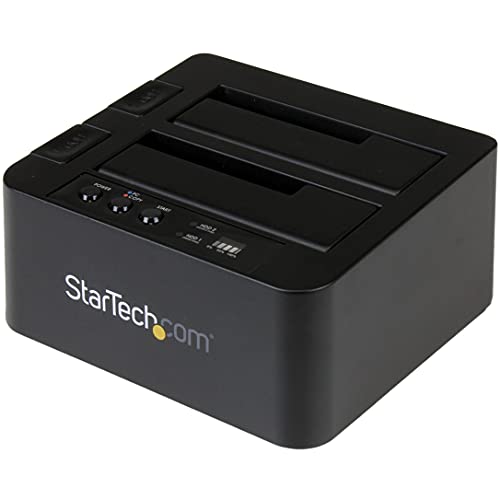
- Copies drives at up to 28GB/min
- Supports SATA HDDs and SSDs of any capacity
- USB 3.2 Gen 2 connectivity up to 10Gbps
Best For: Fast full-drive SATA cloning
Best Everyday Dock

- 44TB total capacity with 2.5-inch and 3.5-inch SATA support
- Offline cloning without a computer
- USB 3.0, UASP, and tool-free drive swapping
Best For: Editors using standard SATA HDDs and SSDs
Best Versatile Professional
StarTech M.2 and SATA Duplicator

- Supports NVMe, M.2 SATA, and 2.5/3.5-inch SATA drives
- Configurable cloning modes with HPA controls
- Five erase modes including NIST-aligned secure erase
Best For: Studios managing mixed drive formats and sanitization
Best Simple Standalone Unit

- Standalone 1:1 copying without a computer
- Works with 2.5-inch and 3.5-inch SATA drives
- Includes system/file, whole-drive, and DoD erasure modes
Best For: Small teams with routine SATA cloning needs
Five-Bay Workflow Hub

- Five SATA bays with up to 120TB expansion
- Offline cloning without a computer
- 5Gbps USB transfer with progress display
Best For: Multi-drive video editing workstations and large backup workflows
Compact Dual-Bay Choice

- Two bays for 2.5- and 3.5-inch SATA drives
- Offline clone function with no drivers
- USB 3.0 and USB-C connectivity
Best For: Simple two-drive backups and occasional cloning
Connected Editing Station

- Dual-bay SATA offline cloning
- Three additional USB 3.0 Type-A ports
- Up to 48TB total drive capacity
Best For: Compact editing desks needing drive cloning and USB expansion
Versatile NVMe Workbench – Rosewill Triple-Bay Cloner Dock
For editors managing a mix of M.2 NVMe, SATA SSD, and 2.5- or 3.5-inch HDD media, the Rosewill RS-N2S-CL is one of the more flexible hard drive duplicators for video editing. It supports offline cloning without a host computer and also works as a USB 3.2 Gen 2 docking station with transfer speeds up to 10Gbps.
Best For: Video editors and creators who need one compact dock for cloning and accessing several drive types.
Pros:
- Supports M.2 NVMe, SATA SSD, and 2.5- or 3.5-inch HDDs.
- Offline cloning works without connecting to a computer.
- USB 3.2 Gen 2×1 provides transfer speeds up to 10Gbps.
- Tool-free, compact design is convenient for mobile workflows.
Cons:
- Its plastic enclosure may be less substantial than a steel duplicator.
- The product notes do not specify a cloning speed.
The Rosewill stands out when your editing setup uses multiple storage formats. Its triple-bay design and broad compatibility offer more flexibility than a basic SATA-only dock, while the offline function simplifies drive-to-drive duplication.
Image Library Specialist – StarTech SATA Duplicator
The StarTech SATDUP11IMG is aimed at repeatable backup and deployment work rather than simple one-off copying. As hard drive duplicators for video editing, its four duplication modes and disk image library can help teams preserve, restore, or deploy SATA-based project and system drives without a computer.
Best For: Editors, studios, and IT teams that need organized image backups and repeatable SATA drive duplication.
Pros:
- Creates and manages multiple disk images on a library drive.
- Offers System and File, All Partitions, Percentage Copy, and Sector-by-Sector modes.
- Supports 2.5- and 3.5-inch SATA HDDs and SSDs of any capacity.
- Standalone operation includes an LCD menu and LED indicators.
Cons:
- It is limited to SATA drives without separately purchased adapters.
- The listed 6GB/min speed is lower than the faster StarTech dock in this roundup.
This model makes the most sense when image management matters as much as cloning. Its LCD-controlled library can reduce repetitive setup work, though editors working with NVMe drives or seeking the fastest transfers will need another solution.
Simple Two-Drive Copy Station – Sabrent Dual-Bay Cloner
The Sabrent EC-HD2B is a straightforward dual-bay dock for editors who want to read or clone standard SATA drives without installing software. Among hard drive duplicators for video editing, it offers offline cloning, USB 3.0 connectivity, and support for 2.5- and 3.5-inch drives up to 10TB.
Best For: Budget-conscious editors who work with standard SATA HDDs or SSDs and want a simple two-drive setup.
Pros:
- Supports both 2.5- and 3.5-inch SATA HDDs and SSDs.
- Offline cloning requires no computer or drivers.
- Dual-bay design can hold source and target drives together.
- Supports hard drives up to 10TB and USB 3.0 transfer speeds up to 5Gbps.
Cons:
- It does not support M.2 or NVMe drives.
- Offline cloning is listed at up to 60Mbps, which is modest for large video libraries.
- Only two drives are supported at once.
The Sabrent is a practical entry-level choice for SATA-based editing storage. It keeps the process simple and accessible, but large-footage workflows may take longer during offline duplication than with the faster alternatives here.
Fast Sector Copier – StarTech Dual-Bay Duplicator Dock
The StarTech SDOCK2U313R is built for fast, full-drive duplication of SATA storage. Its sector-by-sector copier reaches up to 28GB/min, and the dock doubles as a USB-to-SATA adapter, making it a strong option among hard drive duplicators for video editing when large project drives need to be copied without a computer.
Best For: Editors and technical users cloning large SATA project drives quickly while retaining complete drive contents.
Pros:
- Copies entire drives sector by sector at speeds up to 28GB/min.
- Works with 2.5- and 3.5-inch SATA HDDs and SSDs of any capacity.
- Supports 4Kn, TRIM, and SATA I/II backward compatibility.
- Also functions as a USB-to-SATA docking station with up to 10Gbps host connectivity.
Cons:
- The target disk must be equal to or larger than the source disk.
- It is designed for SATA drives and does not provide native NVMe support.
- Sector-by-sector copying also includes empty sectors.
This StarTech is the performance-focused choice for SATA workflows. Its high listed duplication rate and broad drive compatibility suit large editing volumes, while the sector-by-sector method favors complete copies over selective file-level transfers.
Best Everyday Dock – ORICO Dual-Bay Offline Cloner
The ORICO Dual Bay Hard Drive Docking Station is a practical choice among hard drive duplicators for video editing when you need straightforward SATA drive cloning, backups, or file transfers. Its offline clone button works without a computer, while USB 3.0 and UASP support help provide convenient access to installed drives.
Best For: Video editors who work with 2.5-inch or 3.5-inch SATA HDDs and SSDs and want a compact dock for cloning, backups, and drive transfers.
Pros:
- Supports up to 44TB total across two SATA drives.
- Offline cloning requires no computer or software.
- Works with Windows, Mac, Linux, iPad OS, and Android devices.
- Tool-free design supports quick drive swapping.
Cons:
- Offline cloning requires the target disk to be larger than the source.
- USB 3.0 connection is rated up to 5Gbps rather than newer USB speeds.
- The dock will not power on without a hard drive inserted.
Choose this ORICO model if your editing workflow centers on standard SATA media and you value simple, computer-free duplication. Its broad device compatibility also makes it useful beyond the editing desk.
Best Versatile Professional – StarTech M.2 and SATA Duplicator
The StarTech Dual-Bay Duplicator is one of the more flexible hard drive duplicators for video editing because it handles M.2 NVMe, M.2 SATA, and 2.5-inch or 3.5-inch SATA drives. It operates without a PC or software and adds configurable duplication, erasure, and host protected area options through an on-screen interface.
Best For: Editors, studios, and IT teams managing mixed NVMe and SATA media, drive migrations, or secure drive sanitization.
Pros:
- Duplicates between M.2 NVMe, M.2 SATA, and 2.5-inch/3.5-inch SATA drives.
- Supports system/file, all-partition, whole-drive, and percentage duplication modes.
- Offers five erase modes, including secure erase aligned with NIST SP 800-88 Rev. 1.
- On-screen display provides drive information, error reporting, and status indicators.
Cons:
- Its broad feature set may be more than a basic cloning workflow requires.
- Listed memory storage capacity is 16TB.
- IDE and mSATA drives require separate adapters.
This is the strongest fit when an editing operation uses multiple drive formats or needs repeatable sanitization controls. The standalone interface reduces dependence on a workstation during duplication and erasure tasks.
Best Simple Standalone Unit – Systor 1:1 HDD/SSD Duplicator
The Systor SYS101HS-DP keeps the duplication process focused and computer-free, making it a straightforward option among hard drive duplicators for video editing. It supports 2.5-inch and 3.5-inch SATA HDDs and SSDs, with modes for copying systems and files or duplicating an entire drive.
Best For: Editors and small production teams that need a dedicated SATA duplicator for routine drive copies and basic data sanitization.
Pros:
- Standalone operation requires no computer or software.
- Accepts both 2.5-inch and 3.5-inch drives without an adapter.
- Copies systems/files or entire hard drives.
- Supports DoD 5220.22-M-compliant drive erasure.
Cons:
- Supports SATA drives rather than M.2 NVMe media.
- Its listed capacity is 3TB.
- Transfer speed is rated at up to 90MB per second.
The Systor is a sensible choice for uncomplicated SATA-based workflows where ease of use matters more than support for newer interfaces. Its hot-swappable design and standalone operation can simplify recurring backup and replacement-drive tasks.
Five-Bay Workflow Hub – MAIWO 5-Bay SATA Cloner
For video editors managing multiple SATA drives, the MAIWO 5-Bay SATA Cloner combines offline duplication with five-bay storage expansion. It supports 2.5-inch and 3.5-inch SATA HDDs and SSDs, offers USB 3.0 transfer speeds up to 5Gbps, and can read and write multiple drives simultaneously.
Best For: Editors, creators, and IT users who need a high-capacity multi-drive station for backups, transfers, and drive cloning.
Pros:
- Five bays support up to 120TB total capacity, based on five 24TB drives.
- Offline cloning works without connecting to a computer.
- Digital 0%-100% progress display and completion alerts simplify monitoring.
- Tool-free design and open construction support convenient installation and heat dissipation.
Cons:
- Its larger five-bay footprint may be excessive for users who only duplicate one drive at a time.
- Offline cloning is designed for SATA drives rather than other drive interfaces.
Among hard drive duplicators for video editing, this is the most expandable option in the group. Choose it when your workflow involves several SATA drives and frequent backup or transfer tasks.
Compact Dual-Bay Choice – WAVLINK Dual-Bay SATA Dock
The WAVLINK Dual-Bay SATA Dock is a compact option for video editors who need to duplicate or access two 2.5-inch or 3.5-inch SATA drives. It supports USB 3.0 and USB-C connections, UASP transfer speeds up to 6Gbps, and offline cloning from a source drive to a target drive.
Best For: Editors who want a straightforward two-drive duplicator for desktop backups, drive access, and occasional cloning.
Pros:
- Dual bays accommodate both 2.5-inch and 3.5-inch SATA HDDs and SSDs.
- Offline cloning requires no computer or drivers.
- UASP support can provide transfer speeds up to 6Gbps, with USB 3.0 compatibility.
- Supports hot-swapping and automatic sleep after 30 minutes of inactivity.
Cons:
- Offline cloning requires the target drive to be equal to or larger than the source.
- It is not compatible with M1- or M2-based Macs.
- Two bays provide less expansion than a multi-bay station.
This WAVLINK model keeps the setup simple and compact while covering common SATA duplication needs. Verify your computer platform and target-drive capacity before buying, especially if you use an Apple silicon Mac.
Connected Editing Station – MAIWO Dual-Bay Hub Cloner
The MAIWO Dual-Bay Hub Cloner combines offline SATA drive duplication with three built-in USB 3.0 ports. For video editing setups, it provides a practical way to access or back up 2.5-inch and 3.5-inch HDDs and SSDs while keeping USB accessories connected to the same station.
Best For: Video editors who need a compact dual-bay duplicator with extra USB connectivity for flash drives and peripherals.
Pros:
- Supports 2.5-inch and 3.5-inch SATA HDDs and SSDs, with up to 48TB across two 24TB drives.
- Offline cloning works without a computer and shows 25%-50%-75%-100% progress indicators.
- USB 3.0 provides bandwidth up to 5Gbps and adds three Type-A hub ports.
- Includes an independent 12V/3A power supply for the dock.
Cons:
- It has only two drive bays, limiting simultaneous drive capacity.
- The enclosure is made from ABS plastic rather than metal.
- The USB hub is Type-A based, so newer devices may require an adapter.
This model is a useful middle ground for editors who want offline duplication without giving up desk space or USB ports. Its dual-bay design suits routine backup and transfer work better than large-scale multi-drive archiving.
How We Picked the Best Hard Drive Duplicators for Video Editing
We evaluated these duplicators by looking at the features that matter most in media-production workflows: supported drive types, cloning method, stated transfer rate, bay count, host connectivity, ease of use, and compatibility with common 2.5-inch, 3.5-inch, SATA, and M.2 storage. Offline cloning is especially useful when you need a direct drive-to-drive copy without a computer, while reader and dock modes can simplify file transfers and project access.
Advertised speeds are manufacturer claims and can vary with the source drive, destination drive, interface, file sizes, and thermal limits. For video work, sustained real-world performance and reliable handling of large drives are more important than a peak number alone.
Quick Comparison
Dual-bay docks are the most flexible choice for routine cloning and drive access. Models supporting both M.2 and SATA storage are better suited to newer editing workstations that use NVMe scratch or project drives. Triple- and five-bay units can streamline larger backup rotations, while dedicated 1:1 duplicators are designed for repeatable standalone copying or erasing.
- Best for mixed storage: Choose a model supporting M.2 NVMe, M.2 SATA, and 2.5/3.5-inch SATA drives.
- Best for straightforward cloning: A dual-bay offline dock keeps the process simple and computer-free.
- Best for high-volume workflows: Consider a multi-bay dock or a duplicator with a high stated transfer rate.
- Best for controlled duplication: A dedicated 1:1 unit with status information and erase functions may be preferable.
Key Buying Factors for Hard Drive Duplicators for Video Editing
Drive Compatibility
Confirm whether the unit accepts SATA HDDs and SSDs, M.2 SATA, M.2 NVMe, or only one format. A 3.5-inch bay is useful for desktop archive drives, while 2.5-inch support covers many portable SSDs and laptop drives.
Cloning Speed and Interface
USB 3.0 is adequate for many backups, but USB 3.2 Gen 2, USB-C, or a high-speed dedicated duplicator can reduce transfer time when moving large 4K or 8K media libraries. The slowest drive in the chain still limits performance.
Offline Operation and Controls
Offline cloning should include clear source and destination indicators and a simple start process. LCDs, on-screen displays, progress indicators, or image-management features can help when duplicating drives repeatedly.
Capacity, Cooling, and Layout
Check the maximum supported drive capacity and leave room for future storage upgrades. Multi-bay docks improve convenience but require a stable power supply and enough desk space. For long transfers, ventilation and drive spacing also matter.
Who Should Buy Which Hard Drive Duplicators for Video Editing?
Editors working with a mix of NVMe project drives and SATA archives should prioritize a versatile M.2-and-SATA duplicator. Freelancers and home studios that mostly clone one drive at a time can save space with a basic dual-bay dock. Production teams managing several backup drives may benefit from a five-bay model. If your priority is repeatable sector-level duplication, drive erasure, and minimal computer involvement, choose a dedicated 1:1 duplicator rather than a general-purpose reader dock.