
Replacing or upgrading a drive is easier when you can copy an existing disk without reinstalling everything from scratch. The best hard drive duplicators make that process faster, more repeatable, and less dependent on a computer.
This roundup compares 10 standalone duplicators and docking stations, including dual-bay, multi-bay, SATA, USB, and NVMe-capable models. Use the guide below to match speed, compatibility, capacity, and erasure features to your workflow.
Best 10 Hard Drive Duplicators Picks for 2026
Best Value
SABRENT Dual-Bay SATA Dock and Cloner

- Supports 2.5-inch and 3.5-inch SATA HDDs and SSDs
- Offline cloning with no drivers required
- USB 3.0 connectivity and support for drives up to 10TB
Best For: Simple home backups, drive upgrades, and two-drive cloning
Best for IT Sanitization
StarTech 1:1 SATA Duplicator and Eraser

- Three duplication modes for flexible copying
- Four erase modes, including three-pass overwrite
- Copy & Compare helps verify completed clones
Best For: IT deployments, recovery work, and drive sanitization
Best Multi-Drive Dock
SABRENT 4-Bay USB 3.0 Clone Dock

- Four trayless bays for 2.5-inch and 3.5-inch SATA drives
- Offline drive-to-drive cloning without a computer
- USB 3.0 connection with backward compatibility
Best For: Managing multiple SATA drives from one desktop dock
Best Performance
StarTech Dual-Bay SATA Duplicator Dock
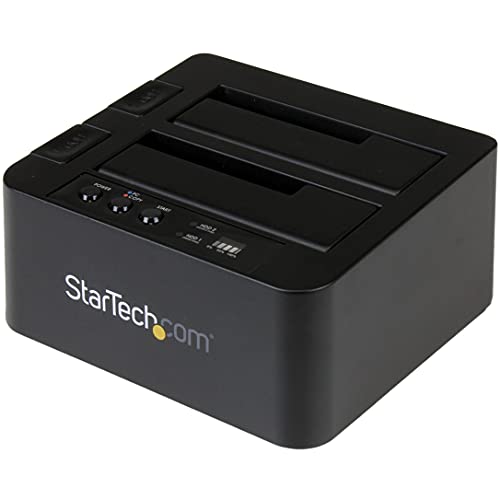
- Standalone cloning at up to 28GB/min
- USB 3.2 Gen 2 connectivity and SATA III support
- Tool-less dual-bay design with 4Kn and TRIM support
Best For: Fast drive cloning plus computer-based SATA drive access
Most Versatile
ICY BOX Triple-Bay NVMe and SATA Cloner

- Three bays support NVMe and SATA drives
- One-touch offline cloning requires no software
- USB 3.2 Gen 2 reaches up to 10 Gbps
Best For: Mixed NVMe and SATA drive workflows
Best for Professional Duplication
Systor Standalone HDD/SSD Duplicator

- Standalone copying and erasing needs no computer
- Supports 2.5-inch and 3.5-inch SATA drives
- DoD 5220.22-M-compliant sanitization is included
Best For: Business SATA duplication and drive erasure
Best Value Dock
ORICO Dual-Bay SATA Hard Drive Cloner

- Offline cloning works without a computer
- Supports two 2.5-inch or 3.5-inch SATA drives
- Handles up to 44TB across two 22TB drives
Best For: Home SATA backups and drive upgrades
Fast Standalone Workhorse

- Standalone copying and erasing
- Supports 3.5-inch HDDs and 2.5-inch SSDs
- Up to 150MB/s with DoD sanitization
Best For: SATA duplication and sanitization without a computer
Dual-Bay Cloning Dock

- Standalone dual-bay SATA cloning
- USB 3.0 and eSATA host connections
- Up to 22GB/min sector-by-sector copying
Best For: IT professionals needing cloning and drive access in one dock
Multi-Interface Sanitizer

- Clones and erases SATA and USB media
- Five erase modes, including DoD overwrite
- LCD controls and Copy & Compare verification
Best For: Mixed-media duplication and secure drive sanitization
Best Value – SABRENT Dual-Bay SATA Dock and Cloner
If you need one of the more straightforward hard drive duplicators for home upgrades or routine backups, the SABRENT EC-HD2B combines a two-drive dock with offline cloning. It accepts standard 2.5-inch and 3.5-inch SATA hard drives or SSDs, requires no drivers, and connects to a computer over USB 3.0.
Best For: Users who want an affordable, plug-and-play dock for two SATA drives and occasional offline cloning.
Pros:
- Supports both 2.5-inch and 3.5-inch SATA HDDs and SSDs.
- Offers offline cloning without requiring a computer.
- Supports drives up to 10TB and lists 20TB total storage capacity.
- USB 3.0 transfer speeds reach up to 5Gbps.
Cons:
- Offline cloning is listed at up to 60Mbps, slower than its USB connection speed.
- It has only two drive bays.
- The warranty is one year unless registration extends coverage to two years.
The EC-HD2B is a practical choice when simplicity and broad SATA compatibility matter more than advanced erase or verification features. Its dual-bay design keeps drive access and cloning relatively simple.
Best for IT Sanitization – StarTech 1:1 SATA Duplicator and Eraser
For IT work that involves both copying and securely clearing drives, the StarTech SATDUP11 is a purpose-built option among hard drive duplicators. This standalone unit supports 2.5-inch and 3.5-inch SATA HDDs and SSDs, with selectable duplication and erase modes controlled through its LCD menu.
Best For: IT professionals handling disk deployments, recovery, backups, and drive sanitization.
Pros:
- Provides three duplication modes, including sector-by-sector, system and file, and all-partitions copying.
- Includes four erase modes, including single- and three-pass overwrite options.
- Supports 2.5-inch and 3.5-inch SATA drives of any capacity.
- Copy & Compare can verify the cloned drive after duplication.
Cons:
- Adapters for eSATA, mSATA, IDE, and M.2 SATA drives are sold separately.
- Its 1:1 design supports only two drives at a time.
- The interface is focused on standalone operation rather than general multi-drive docking.
With dedicated erase controls, an LCD menu, and verification through Copy & Compare, the SATDUP11 is more specialized than a basic cloning dock. It is a strong fit for repeatable IT workflows where sanitization is as important as duplication.
Best Multi-Drive Dock – SABRENT 4-Bay USB 3.0 Clone Dock
The SABRENT DS-U3B4 is a useful choice when you need more than a two-drive setup. As hard drive duplicators go, its four trayless bays are especially convenient for accessing, backing up, and managing multiple 2.5-inch or 3.5-inch SATA drives from one USB 3.0-connected dock.
Best For: Users who regularly manage several SATA drives and want four bays in a single desktop dock.
Pros:
- Holds up to four 2.5-inch or 3.5-inch SATA HDDs and SSDs.
- Trayless design allows direct drive insertion without tools.
- Supports offline drive-to-drive cloning without a computer.
- USB 3.0 offers transfers up to 5Gbps and works with USB 2.0 systems.
Cons:
- The offline clone function is designed for drive-to-drive cloning rather than simultaneous multi-drive cloning.
- It is larger than a two-bay dock.
- The warranty is limited to one year.
The DS-U3B4 makes the most sense for users who value capacity and convenient drive access. Its four-bay layout reduces the need to swap drives, while the offline clone feature adds flexibility for straightforward duplication tasks.
Best Performance – StarTech Dual-Bay SATA Duplicator Dock
The StarTech SDOCK2U313R is a high-speed dual-bay option for users who want standalone cloning plus computer-based drive access. It supports 2.5-inch and 3.5-inch SATA HDDs and SSDs, uses sector-by-sector copying at up to 28GB/min, and includes USB 3.2 Gen 2 connectivity.
Best For: Users who prioritize fast standalone cloning, broad SATA compatibility, and a dual-purpose docking station.
Pros:
- Standalone sector-by-sector cloning works without a computer.
- Copy speeds are listed at up to 28GB/min.
- Supports 2.5-inch and 3.5-inch SATA drives of any capacity and is 4Kn compatible.
- Tool-less design includes drive doors, eject buttons, TRIM, and USB 3.2 Gen 2 connectivity.
Cons:
- The target drive must be equal to or larger than the source drive.
- IDE drives require a separately sold adapter.
- Only two drives can be installed at once.
The SDOCK2U313R is a strong all-around pick when cloning speed and connectivity matter. Its sector-by-sector copier is straightforward, while the dock mode lets you access SATA drives from a computer when standalone duplication is not needed.
Most Versatile – ICY BOX Triple-Bay NVMe and SATA Cloner
For shoppers comparing hard drive duplicators, the ICY BOX stands out when multiple drive formats matter. Its three tool-free bays support M.2 PCIe NVMe, 2.5-inch SATA, and 3.5-inch SATA drives, while one-touch offline cloning avoids software or computer setup.
Best For: Users who need flexible NVMe and SATA cloning, drive access, and fast USB-C connectivity in one station.
Pros:
- Supports cloning between NVMe and SATA drive types.
- Three independent bays allow simultaneous drive access.
- USB 3.2 Gen 2 provides transfer speeds up to 10 Gbps.
- Includes USB-C/USB-A cable options and a 24-month warranty.
Cons:
- Its plastic enclosure may be less rugged than a metal duplicator.
- NVMe and SATA support may be more capability than needed for basic SATA-only cloning.
The ICY BOX is the strongest all-around choice for mixed storage environments. It combines offline operation with broad compatibility, three-bay convenience, and modern USB performance.
Best for Professional Duplication – Systor Standalone HDD/SSD Duplicator
The Systor SYS101HS-DP is a purpose-built option among hard drive duplicators for standalone copying and erasing. It requires no computer or software, supports 2.5-inch and 3.5-inch SATA drives without an adapter, and maintains its listed 90MB-per-second speed even when multiple drives are loaded.
Best For: Businesses and technicians who need SATA drive duplication plus DoD 5220.22-M-compliant sanitization.
Pros:
- Standalone operation does not require a computer or software.
- Copies data-only or entire hard drives.
- Supports drive erasure with DoD 5220.22-M compliance.
- Offers hot-swappable support and compatibility with 2.5-inch and 3.5-inch SATA drives.
Cons:
- Supports SATA drives rather than the newer NVMe format.
- The listed 90MB-per-second transfer rate is slower than newer 10Gbps USB solutions.
Choose the Systor when reliable standalone SATA duplication and secure erasure are more important than the newest interface speeds. Its extended labor warranty and lifetime technical support are useful for ongoing business use.
Best Value Dock – ORICO Dual-Bay SATA Hard Drive Cloner
The ORICO dual-bay dock is a practical choice for shoppers seeking approachable hard drive duplicators for 2.5-inch and 3.5-inch SATA drives. Its offline clone button works without a computer, while USB 3.0, UASP, and tool-free hot swapping make it useful for routine backups and drive transfers.
Best For: Home users who want a compact SATA cloning dock with broad device compatibility and support for up to 44TB across two drives.
Pros:
- Offline cloning starts by holding the CLONE button for about three seconds.
- Supports 2.5-inch and 3.5-inch SATA I/II/III HDDs and SSDs.
- Supports up to 44TB using two 22TB drives.
- Works with Windows, Mac, Linux, iPadOS, Android, and several consumer devices.
Cons:
- The target disk must be larger than the source disk for offline cloning.
- USB 3.0 tops out at the listed 5Gbps protocol speed, below newer USB 3.2 Gen 2 docks.
- It will not power on without a hard drive inserted.
The ORICO offers a straightforward balance of price-conscious design, offline cloning, and everyday SATA compatibility. It is a good fit for home backups and drive upgrades, provided its source-and-target cloning requirement works for your setup.
Fast Standalone Workhorse – Systor SYS201HS-DP
For buyers comparing hard drive duplicators, the Systor SYS201HS-DP is a straightforward standalone option for copying or sanitizing SATA drives without a computer or software. It supports both 3.5-inch hard drives and 2.5-inch SSDs without an adapter, with speeds up to 150MB per second.
Best For: IT workflows that need repeatable SATA duplication and drive erasure without relying on a host computer.
Pros:
- Standalone operation requires no computer or software.
- Supports 3.5-inch HDDs and 2.5-inch SSDs without an adapter.
- Copies multiple drives at up to 150MB per second, with speed remaining consistent as loads increase.
- Offers data-only or whole-drive duplication plus DoD 5220.22-M-compliant sanitization.
Cons:
- Designed for SATA drives; other interfaces require a different solution.
- Its 1:1 format may be less suitable for users needing a larger multi-target duplicator.
The Systor is a practical choice when simplicity, consistent throughput, and built-in sanitization matter more than broad interface support. Its included warranty and lifetime technical support add reassurance for ongoing professional use.
Dual-Bay Cloning Dock – StarTech SDOCK2U33RE
Among hard drive duplicators, the StarTech SDOCK2U33RE stands out as a dual-bay dock that combines standalone cloning with computer-connected drive access. It handles 2.5-inch and 3.5-inch SATA HDDs and SSDs, and connects through USB 3.0 or eSATA.
Best For: IT professionals who want a standalone cloning dock that can also serve as a reusable drive-access station.
Pros:
- Clones SATA drives without a PC and supports drives of any capacity.
- Works with SATA I, II, and III, including 4Kn-compatible drives.
- Offers USB 3.0 and eSATA connectivity for accessing mounted drives.
- Copies entire drives sector by sector at up to 22GB per minute.
Cons:
- The target disk must be equal to or larger than the source disk.
- IDE drives require a separately sold adapter.
- Sector-by-sector copying also copies empty sectors.
This StarTech dock is especially versatile for technicians who need both offline cloning and occasional file recovery or disk mounting. Its toolless, top-loading design keeps routine drive swaps simple.
Multi-Interface Sanitizer – StarTech SU2DUPERA11
For buyers seeking hard drive duplicators with erasure features, the StarTech SU2DUPERA11 combines 1:1 cloning with sanitization for SATA HDDs, SSDs, and USB thumb drives. Its LCD menu and push-button controls provide access to multiple copy and erase modes without requiring a computer.
Best For: Organizations that need to duplicate and securely erase both SATA drives and USB flash media.
Pros:
- Supports 2.5-inch and 3.5-inch SATA drives plus USB thumb drives.
- Provides four duplication modes and five erase modes.
- Supports cross-interface copying between USB and SATA media.
- Includes Copy & Compare for verifying a completed clone.
Cons:
- USB duplication is slower than SATA, at up to 2.4GB per minute.
- eSATA, mSATA, IDE, and M.2 SATA support requires separately sold adapters where applicable.
- Its 1:1 design is intended for one source and one target at a time.
The SU2DUPERA11 is a strong fit when drive wiping is as important as copying. Its varied erase modes, LCD controls, and verification feature make it more capable than a basic cloning dock for media-handling workflows.
How We Picked the Best Hard Drive Duplicators
We focused on the features that matter during real-world cloning and disk-management tasks: source-to-target copying, drive-format compatibility, standalone operation, connection options, advertised transfer speed, bay count, and support for both 2.5-inch and 3.5-inch drives. We also considered whether each unit is better suited to occasional upgrades, routine backup work, IT deployment, or secure drive retirement.
Specifications can vary by drive type, interface, file system, and workload. Treat stated speeds as maximum or ideal figures rather than guaranteed sustained performance, and confirm the manufacturer’s compatibility requirements before buying.
Quick Comparison
| Best For | What to Look For |
|---|---|
| Occasional drive upgrades | Simple dual-bay cloning and broad SATA support |
| Frequent disk duplication | Standalone 1:1 operation and higher advertised copy speeds |
| Multiple-drive workflows | Four bays or multi-drive reader functionality |
| Modern SSD systems | NVMe support, USB-C, and 10Gbps connectivity |
| Secure reuse or disposal | Dedicated erasure modes and verification controls |
Key Buying Factors for Hard Drive Duplicators
Drive and Interface Compatibility
Check whether the duplicator supports 2.5-inch and 3.5-inch SATA HDDs and SSDs. A SATA-only unit will not copy M.2 NVMe drives unless a suitable adapter is explicitly supported. If your equipment includes newer PCIe-based SSDs, choose a model with native NVMe support rather than assuming all M.2 drives are interchangeable.
Standalone Cloning Versus Computer-Based Copying
Standalone units can clone one drive to another using onboard controls, which is useful for migrations, repairs, and repeatable deployments. Docking stations connected by USB are often more flexible for browsing, backups, and general storage access, but may rely on operating-system software for cloning.
Speed and Capacity
Higher advertised speeds can reduce waiting time, but actual performance depends on the slowest drive, interface, data pattern, and thermal limits. Confirm that the target drive is at least as large as the source when performing a sector-based clone, and check whether the device supports larger-capacity disks.
Erasing, Verification, and Convenience
If you regularly retire or repurpose drives, look for dedicated erase functions and clear status indicators. For routine upgrades, tool-free bays, independent power controls, USB 3.x or USB-C connectivity, and accessible drive slots may matter more than peak throughput.
Who Should Buy Which Hard Drive Duplicators?
Home users and occasional upgraders: Choose a straightforward dual-bay SATA dock with one-button cloning and broad 2.5-inch/3.5-inch support.
Technicians and small businesses: A standalone 1:1 duplicator with higher throughput and erasure features is better for repeat deployments, diagnostics, and drive retirement.
Users managing several drives: A four-bay dock simplifies copying data between multiple disks and accessing several storage devices from one workstation.
NVMe and mixed-drive owners: Select a USB-C model that specifically lists NVMe and SATA support, since connector shape alone does not guarantee protocol compatibility.