
Hard drive duplicators can create offline backup copies without relying on a computer, making them useful for IT technicians, repair shops, photographers, and anyone managing several drives.
Our selection includes standalone HDD and SSD duplicators, USB docking stations, M.2-compatible models, and specialized media-copying equipment. The right choice depends on drive format, copy speed, capacity, and whether you need erasing or analysis features.
Best 10 Hard Drive Duplicators for Backups Picks for 2026
Best Multi-Drive Workstation
4-Bay HDD/SSD Duplicator and Eraser

- Standalone 1:3 cloning
- Quick and Secure Erase modes
- Supports SATA and IDE drives
Best For: IT teams handling cloning, wiping, and drive access
Best Optical Media Backup Tool
Flash and Disc to DVD Duplicator

- Copies USB, CF, SD, and MS media
- Standalone LCD-controlled operation
- Supports disc-to-disc duplication
Best For: Archiving compatible flash media to CDs or DVDs
Best Simple Dual-Bay Dock

- Two-bay SATA drive dock
- Offline cloning without drivers
- Supports drives up to 10TB
Best For: Straightforward home and small-office drive cloning
Best Image-Library Duplicator
1:1 SATA Backup and Restore Tool

- Stores multiple drive images
- Four selectable copy modes
- Up to 6 GB/min SATA III copying
Best For: System deployment and repeatable PC or server restores
Best Multi-Drive Dock

- Four bays support 2.5-inch and 3.5-inch SATA drives
- Offline cloning works without a computer
- USB 3.0 and trayless plug-and-play design
Best For: Multi-drive backup and storage management
Best Professional Duplicator
StarTech Dual-Bay SATA Duplicator
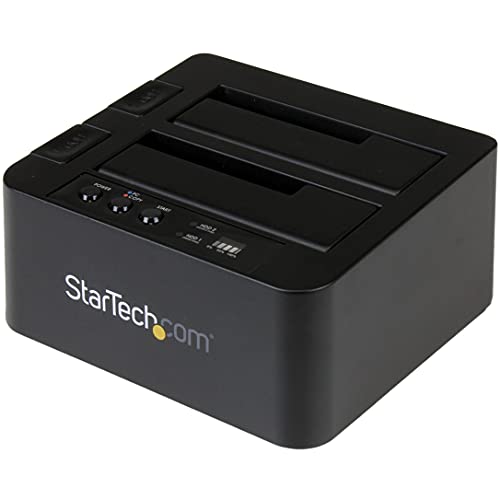
- Standalone cloning reaches up to 28GB per minute
- Supports 2.5-inch and 3.5-inch SATA HDDs and SSDs
- Includes sector-by-sector copying and USB 3.2 Gen 2
Best For: IT workflows and full-drive duplication
Best for Sanitization

- Standalone copying requires no computer or software
- Supports 2.5-inch and 3.5-inch SATA drives
- Adds DoD 5220.22-M-compliant drive erasure
Best For: Backup duplication and secure drive disposal
Most Versatile

- Clones M.2 NVMe, M.2 SATA, and 2.5/3.5-inch SATA drives
- Standalone operation with configurable duplication modes
- Includes NIST-aligned Secure Erase options
Best For: Mixed-drive backup and sanitization workflows
Best for Batch Cloning

- Duplicates one SATA drive to up to three targets
- Copies at up to 36GB/min per channel
- Includes HPA/DCO support and multiple erase modes
Best For: Business, lab, and repeatable multi-drive projects
Best Value Dock

- Offline one-key cloning for 2.5- and 3.5-inch SATA drives
- Supports up to 40TB across two bays
- USB 5Gbps connectivity for computers and compatible devices
Best For: Home and office SATA backups and drive access
Best Multi-Drive Workstation – 4-Bay HDD/SSD Duplicator and Eraser
For IT teams comparing hard drive duplicators for backups, the StarTech SATDOCK4U3RE stands out with four bays, standalone 1:3 cloning, and drive-erasing functions. It supports 2.5- and 3.5-inch SATA drives, with included adapters for IDE drives, and can also operate as a USB or eSATA docking station.
Best For: IT professionals who need multi-drive cloning, disk wiping, and flexible drive access from one unit.
Pros:
- Clones up to three target drives at up to 4.2 GB/min without an operating system.
- Supports 2.5/3.5-inch SATA drives plus IDE drives through included adapters.
- Offers Quick Erase and Secure Erase, including NIST SP 800-88 Rev. 1 Purge support.
- Four bays and USB 3.2 Gen 1 or eSATA connectivity add practical flexibility.
Cons:
- Target drives must be equal to or larger than the source drive for duplication.
- Its professional feature set may be more than needed for occasional home backups.
This is the most versatile option here for repeatable, multi-drive workflows. Its standalone operation, erase modes, and included connectivity make it particularly useful for technicians managing backups, replacements, and drive sanitization.
Best Optical Media Backup Tool – Flash and Disc to DVD Duplicator
The Acumen Disc AD01-MM is a specialized choice among hard drive duplicators for backups, since it copies flash media or discs to CD and DVD rather than cloning hard drives. Its standalone design accepts USB, CF, SD, and MS media and uses a simple LCD menu for operation.
Best For: Users archiving compatible memory cards, USB drives, CDs, or DVDs to recordable optical media.
Pros:
- Supports USB drives, CompactFlash, Secure Digital, and Memory Stick media.
- Can duplicate flash media to DVD/CD or copy one disc to another.
- Standalone operation uses a large LCD and four-button control layout.
- Multi-session technology can combine multiple smaller memory-card backups onto discs.
Cons:
- It does not copy encrypted, copyrighted, or copy-protected discs and games.
- It is not a hard-drive duplicator and is limited to optical-media backup workflows.
- Optical duplication is slower and less convenient than modern drive-to-drive cloning.
This unit makes sense only when DVD/CD archiving is part of the backup plan. Buyers seeking SATA HDD or SSD cloning should choose one of the dedicated drive duplicators instead.
Best Simple Dual-Bay Dock – USB 3.0 HDD/SSD Cloner
The SABRENT EC-HD2B is a straightforward option for hard drive duplicators for backups when you want a compact two-bay dock. It supports standard 2.5- and 3.5-inch SATA HDDs and SSDs, provides offline cloning, and connects to a computer over USB 3.0 for drive access.
Best For: Home users and technicians who need uncomplicated SATA drive cloning or a basic dual-drive docking station.
Pros:
- Supports both 2.5- and 3.5-inch SATA hard drives and SSDs.
- Performs offline cloning without requiring drivers or a computer.
- Supports drives up to 10TB and transfer speeds up to 5Gbps over USB 3.0.
- Includes the docking station, power supply, USB 3.0 cable, and manual.
Cons:
- It has two bays and is less suited to high-volume multi-drive duplication.
- Offline cloning is specified at up to 60Mbps, below its USB 3.0 computer-transfer rate.
- The listed warranty is one year unless registration extends coverage to two years.
This is a practical entry-level dock for occasional cloning and drive reading. Its dual-bay layout keeps the workflow simple, while USB 3.0 makes it useful as an everyday external drive dock as well.
Best Image-Library Duplicator – 1:1 SATA Backup and Restore Tool
For structured hard drive duplicators for backups, the StarTech SATDUP11IMG adds a disk-image library to standard 1:1 SATA cloning. It can store multiple host-drive images on a single library drive, then restore them without connecting the duplicator to a computer.
Best For: IT specialists and system integrators deploying or restoring standardized PC and server images.
Pros:
- Stores and manages multiple disk images on one library drive.
- Provides four duplication modes, including system/file, all partitions, percentage, and sector-by-sector copying.
- Offers up to 6 GB/min copy speed with SATA III support.
- Standalone LCD controls simplify image backup, restoration, and drive information checks.
Cons:
- It is a 1:1 duplicator, so it does not clone several target drives simultaneously.
- Adapters for eSATA, mSATA, IDE, and M.2 SATA are sold separately.
- Its image-library features are geared more toward professional deployment than casual backups.
This is the strongest fit for repeatable system imaging rather than simple one-off drive copying. The image library can reduce the need to carry multiple backup drives when restoring standardized systems.
Best Multi-Drive Dock – SABRENT 4-Bay USB 3.0 Dock
The SABRENT DS-U3B4 is a practical choice among hard drive duplicators for backups when you need to access or manage several SATA drives from one station. Its four trayless bays support both 2.5-inch and 3.5-inch HDDs and SSDs, while the offline clone function can copy drives without a computer.
Best For: Users who need four-drive access, convenient backups, and occasional computer-free cloning.
Pros:
- Supports up to four 2.5-inch or 3.5-inch SATA HDDs and SSDs.
- Offline drive-to-drive cloning requires no computer or software.
- USB 3.0 provides transfers up to 5Gbps and works with USB 2.0 systems.
- Trayless, plug-and-play design includes an external power adapter.
Cons:
- The offline clone function is intended for direct drive-to-drive copying rather than multi-drive duplication.
- All connected drives must be installed with the dock powered off.
Choose this model if flexibility and capacity matter more than specialized sanitization features. Its four bays make it especially useful as a backup and drive-management hub.
Best Professional Duplicator – StarTech Dual-Bay SATA Duplicator
The StarTech SDOCK2U313R is a focused option among hard drive duplicators for backups, offering standalone sector-by-sector cloning for 2.5-inch and 3.5-inch SATA drives. It also doubles as a USB-to-SATA docking station, making it useful for both duplication and routine drive access.
Best For: IT professionals and advanced users who want standalone cloning, broad SATA compatibility, and fast USB connectivity.
Pros:
- Clones drives without a computer at speeds up to 28GB per minute.
- Sector-by-sector copying works with any file format and includes empty sectors.
- Supports 2.5-inch and 3.5-inch SATA HDDs and SSDs, including 4Kn drives and TRIM.
- Includes USB-C and USB-A cables, tool-free loading, and drive eject buttons.
Cons:
- The target drive must be equal to or larger than the source drive.
- Its sector-by-sector process copies the entire drive, including empty sectors.
- IDE drives require a separately sold adapter.
This is the strongest fit when dependable standalone duplication and professional-oriented features are priorities. Its dual-bay layout is less suited to users who need more than two drives connected at once.
Best for Sanitization – Systor 1:1 HDD/SSD Duplicator
The Systor SYS101HS-DP provides a straightforward standalone approach to hard drive duplicators for backups, with no computer or software required. It handles 2.5-inch and 3.5-inch SATA HDDs and SSDs and adds drive-erasure capabilities for workflows that also require data sanitization.
Best For: Businesses and individuals who need simple drive copying plus DoD 5220.22-M-compliant erasure.
Pros:
- Operates completely standalone without a computer or software.
- Copies systems and files or duplicates an entire hard drive.
- Supports both 2.5-inch and 3.5-inch drives without an adapter.
- Provides erasure compliant with DoD 5220.22-M data-sanitization requirements.
Cons:
- Its listed transfer speed is up to 90MB per second, slower than the StarTech model’s stated duplication rate.
- This unit is designed for 1:1 duplication rather than connecting multiple source or target drives simultaneously.
The Systor stands out when secure drive retirement is as important as backup duplication. Its simple standalone operation and broad drive-size support make it easy to deploy for personal or business use.
Most Versatile – M.2 and SATA Duplicator
For buyers comparing hard drive duplicators for backups, the StarTech SM2DUPE11 stands out for its broad drive support. It can duplicate M.2 NVMe, M.2 SATA, and 2.5- or 3.5-inch SATA drives without a computer or cloning software, with speeds up to 7.5GBpm.
Best For: IT technicians and businesses that need one standalone tool for mixed-drive cloning and secure erasure.
Pros:
- Supports M.2 NVMe, M.2 SATA, and 2.5/3.5-inch SATA drives.
- Offers System/File, All Partitions, Whole Drive, and Percentage duplication modes.
- Includes multiple erase options, including Secure Erase aligned with NIST SP 800-88 Rev. 1.
- On-screen controls, error reporting, drive information, and tool-less operation simplify use.
Cons:
- It is limited to a one-to-one duplication workflow.
- Its wide range of settings may be more than casual home users need.
This is a strong choice when backup workflows involve several drive formats or require documented sanitization options. Its metal enclosure, included cables, and two-year warranty add practical value for regular professional use.
Best for Batch Cloning – HD Pal Pro 1-to-3 Duplicator
For larger duplication jobs, the Acumen Disc HD Pal Pro is a high-throughput option among hard drive duplicators for backups. It supports 2.5- and 3.5-inch HDDs and SSDs and can copy to multiple drives at up to 600 MB/sec, or 36GB/min, per channel.
Best For: Businesses and labs that need to produce several matching SATA drive copies in a single project.
Pros:
- Supports 1-to-3 duplication for batch copying.
- Provides four copy modes and six erase modes, including Secure and Enhanced Erase.
- Supports HPA/DCO duplication and removal for more complete drive matching.
- Can block modifications to the source drive when accessed through USB.
Cons:
- Its 11-pound weight makes it less portable than compact duplicator docks.
- It is designed around SATA 2.5- and 3.5-inch drives rather than M.2 media.
- The included warranty is one year.
The HD Pal Pro makes the most sense when speed and multiple targets matter more than portability. Its source-protection feature, erase controls, and label-printing support are useful for repeatable business or lab workflows.
Best Value Dock – Dual-Bay SATA Cloner Dock
The SUITOK dual-bay dock is a straightforward pick for home and office users seeking hard drive duplicators for backups. It supports 2.5- and 3.5-inch SATA drives, provides one-key offline cloning, and also connects to a computer over USB 3.2 Gen 1 at up to 5Gbps.
Best For: Users who want an affordable dual-purpose SATA dock for offline cloning, file access, and storage expansion.
Pros:
- Clones drives offline without requiring a computer.
- Supports 2.5- and 3.5-inch SATA drives up to 20TB per bay, for 40TB total capacity.
- USB 5Gbps connectivity supports Windows, macOS, Linux, Chrome OS, and Android OTG.
- Tool-free vertical insertion, LED progress indicators, UASP, TRIM, and S.M.A.R.T. support add convenience.
Cons:
- It supports SATA drives only and does not accommodate M.2 media.
- The 5Gbps interface is slower than the dedicated Acumen duplicator’s stated 600 MB/sec channel speed.
- It has a lightweight ABS enclosure rather than a metal chassis.
This dock is a practical all-rounder for occasional backups and drive transfers. Its offline cloning function is convenient, while the USB connection lets it double as a regular external drive reader for computers and compatible media devices.
How We Picked the Best Hard Drive Duplicators for Backups
We focused on standalone duplicators and docking stations that can copy, clone, or manage storage drives with minimal computer involvement. The lineup covers 2.5-inch and 3.5-inch SATA drives, SATA and NVMe M.2 SSDs, dual-bay and multi-bay designs, and professional 1:1 or 1:3 systems.
We also considered practical differences that affect real-world backup work: supported interfaces, stated transfer rates, source-to-target workflows, USB connectivity, drive capacity limits, display or control options, and extra functions such as drive erasing, verification, image management, and health analysis.
Quick Comparison
| Type | Best For | What to Check |
|---|---|---|
| Dual-bay dock | Home users and occasional cloning | Drive size support, USB speed, and offline cloning |
| Four-bay duplicator | Multiple drives and recurring backup tasks | Copy modes, simultaneous operation, and cooling |
| 1:1 professional duplicator | Technicians and controlled workflows | Verification, logging, erasure, and display controls |
| M.2/SATA duplicator | Mixed modern and legacy storage | NVMe versus SATA compatibility and thermal clearance |
| Media or analysis duplicator | Specialized imaging and diagnostic work | Supported media, analysis tools, and included accessories |
Key Buying Factors for Hard Drive Duplicators for Backups
Drive Compatibility
Confirm whether the unit supports 2.5-inch drives, 3.5-inch drives, SATA SSDs, M.2 SATA devices, NVMe drives, or only one specific format. A SATA M.2 slot does not automatically support NVMe, so check the specifications carefully.
Copy Method and Speed
Offline cloning is convenient because it does not require a host computer, while computer-connected docks can be more flexible for file transfers and drive access. Advertised speeds are usually theoretical; actual results vary with the source drive, target drive, interface, and data condition.
Capacity and Cloning Limits
The target drive generally needs to be at least as large as the source, even when the source contains little data. Some duplicators offer intelligent or partition-aware copying, but others perform a sector-by-sector clone. Check how the device handles larger target capacities, partitions, and bootable drives.
Verification, Erasing, and Reliability
For important backups, choose a model with verification or a way to compare the copied data. Secure erase, write protection, cooling, and clear status indicators are valuable for repeated professional use. A duplicator is not a substitute for maintaining multiple backup copies in separate locations.
Who Should Buy Which Hard Drive Duplicators for Backups?
Choose a compact dual-bay dock if you mainly clone or access occasional 2.5-inch and 3.5-inch SATA drives. It is usually the simplest and most affordable option for home backup routines.
Move to a four-bay model when you routinely handle several drives, maintain multiple backup targets, or need a more organized workstation. For technicians, repair businesses, and evidence-preservation workflows, a dedicated 1:1 or multi-bay duplicator with verification, erasure, and status controls is generally the better fit.
If your storage mix includes newer M.2 NVMe SSDs alongside conventional SATA drives, prioritize a model explicitly designed for both interfaces. Finally, select a specialized disc, flash, or analysis system only when those functions are central to your workflow; otherwise, a standard hard drive duplicator will be easier to use and maintain.