
Schools often need to prepare identical USB drives for lessons, assessments, software deployment, recovery tools, or classroom projects. A standalone duplicator can copy media without tying up a computer, while models with erasing and sanitizing modes help protect student and institutional data.
This roundup compares 10 USB duplicators across different port counts, speeds, form factors, and budgets so administrators and IT teams can choose equipment that matches their workflow.
Best 10 USB Duplicators for Schools Picks for 2026
Best Compact Option

- Standalone duplication and erasure
- Copy & Compare verification
- Up to 1.5 GB/minute
Best For: Small school IT batches and drive sanitization
Best Mid-Size Batch Tool

- Seven target drives at once
- Standalone bit-by-bit copying
- Synchronous and asynchronous modes
Best For: Regular classroom-media and IT batches
Best Touchscreen Controls
- Touchscreen copy and erase menu
- Ten target USB drives
- Supports USB 2.0, 3.0, and 3.1
Best For: Accessible daily duplication by school staff
Best High-Volume Capacity

- Fifteen target drives at once
- Standalone bit-by-bit copying
- Synchronous and asynchronous modes
Best For: Large campus or district-wide USB rollouts
Best for IT Teams

- Copies up to seven USB drives at once
- Offers Copy & Compare verification
- Includes multiple drive-erasure modes
Best For: School IT departments handling duplication and sanitization
Best for High-Volume Copying
Acumen Disc 1:7 USB Duplicator

- Copies up to seven Type-A drives simultaneously
- Advertises speeds up to 35 MB/s
- Includes copy-and-compare and four erase modes
Best For: School IT teams preparing many compatible USB drives
Best for Comfort
EZ Dupe 1:4 Mini USB Plus MK II
- Compact and lightweight for mobile use
- Copies up to four USB drives at once
- Supports asynchronous copying and power-bank operation
Best For: Small schools and technicians needing portable duplication
High-Capacity Pick
Vinpower Digital USBShark 7-Target Duplicator
- Duplicates to seven USB targets
- Standalone, PC-free operation
- Bit-by-bit copying plus secure erase
Best For: High-volume school IT deployments
Verification-Focused Pick
StarTech 1:5 USB Duplicator and Eraser

- Copies or erases five USB drives
- Includes sector-by-sector copy
- Adds verification and overwrite modes
Best For: School technicians managing reuse and sanitization
Portable Starter Pick
BestDuplicator UB300 1:2 USB Copier

- Copies one USB to two targets
- Compact standalone LCD operation
- Includes copying, testing, and erase tools
Best For: Small batches and classroom pilots
Best Compact Option – StarTech 1:2 USB Duplicator
For schools needing a compact tool for preparing a few boot drives or distributing small batches of files, this StarTech model is a practical choice among USB duplicators for schools. It works without a computer and supports duplication, drive erasing, and copy verification through a push-button LCD interface.
Best For: School IT staff managing small batches of USB drives, maintenance media, or secure drive erasure.
Pros:
- Duplicates to two USB drives at up to 1.5 GB per minute.
- Supports file-based and sector-by-sector copying across multiple formats.
- Offers Copy & Compare, error scanning, and quick or overwrite erasure modes.
Cons:
- Only supports two target drives at once.
- Asynchronous copying is limited to source content under 64 MB.
- Some external USB devices may need their own power source.
This is a space-saving option for routine school IT work, especially where verification and sanitization matter more than high-volume duplication.
Best Mid-Size Batch Tool – Systor 1:7 USB Duplicator
The Systor 1:7 gives school technology teams seven target ports for preparing classroom media, installation drives, or other USB batches without using a computer or software. It supports synchronous and asynchronous operation and maintains a listed transfer rate of up to 2 GB per minute.
Best For: Schools that regularly create up to seven matching USB drives in a single batch.
Pros:
- Copies to seven USB drives simultaneously.
- Performs standalone bit-by-bit duplication.
- Supports USB 1.1, 2.0, and 3.0 flash drives, plus USB Type-C drives with an adapter.
Cons:
- USB Type-C drives require an adapter.
- The unit weighs about 10 pounds, making it less convenient to move between rooms.
- Its listed interface is USB 1.1.
For schools with recurring but moderate duplication workloads, this model balances useful capacity with a simpler standalone workflow and professional support coverage.
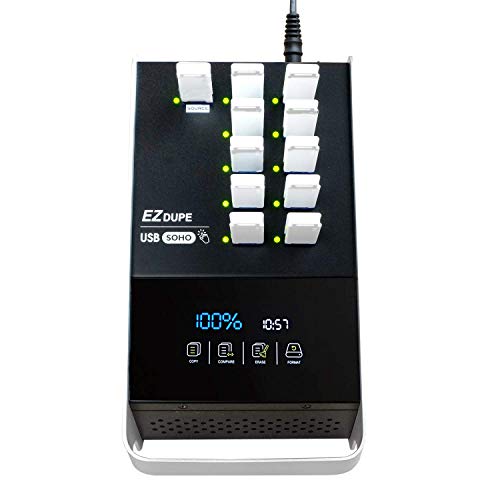
Best Touchscreen Controls – EZ Dupe SOHO Touch 1:10
Schools looking for straightforward operation may prefer the EZ Dupe SOHO Touch. Its touchscreen menu makes copying, comparing, formatting, and erasing easier to access, while support for USB 2.0, 3.0, and 3.1 thumb drives suits mixed device inventories.
Best For: School staff who want guided touchscreen controls for daily USB duplication and media management.
Pros:
- Copies to up to 10 USB drives at a listed 35 MB per second.
- Supports all file formats, file sizes, and drive capacities on USB flash media.
- Includes Smart Copy, Strict Compare, formatting, and one-touch erase functions.
Cons:
- Has a one-year manufacturer warranty.
- The listed 35 MB-per-second speed is lower than the Systor models’ stated 33 MB-per-second transfer figure only by differing unit presentation; actual performance may vary by media.
- It is designed for USB flash media rather than a broader range of external storage devices.
The touchscreen and broad flash-drive compatibility make this a user-friendly choice when multiple staff members may need to perform duplication tasks with minimal training.
Best High-Volume Capacity – Systor 1:15 USB Duplicator
For larger school-wide deployments, the Systor 1:15 provides 15 target ports for duplicating USB media in one batch. It operates without a computer or software, supports synchronous and asynchronous copying, and performs bit-by-bit duplication at up to 2 GB per minute.
Best For: District or campus IT teams preparing large quantities of identical USB drives.
Pros:
- Handles up to 15 target USB drives at once.
- Supports standalone bit-by-bit copying.
- Copy speed remains the same even as the number of loaded drives increases, according to the supplied specifications.
Cons:
- USB Type-C drives require an adapter.
- The larger port count may be unnecessary for small schools or occasional projects.
- Its listed transfer rate is 33 MB per second.
This is the strongest fit when minimizing repeated duplication cycles is the priority. Its high port count can save staff time during district imaging, distribution, or other large USB rollouts.
Best for IT Teams – StarTech 1:7 USB Duplicator
For schools managing boot drives, classroom USB kits, or secure device turnover, this standalone duplicator handles up to seven USB drives without a computer. It supports USB 2.0 and 3.0 media, several copy modes, and drive-erasing options for routine IT work.
Best For: School IT departments that need copying, verification, and data-erasure features in one unit.
Pros:
- Copies to up to seven USB drives simultaneously.
- Supports file-based and sector-by-sector duplication.
- Includes Copy & Compare verification and quick, single-pass, and three-pass erase modes.
- Asynchronous copying can keep the workflow moving for source content under 128 MB.
Cons:
- Asynchronous mode is limited to source content under 128 MB.
- External USB storage devices may need their own power source.
- Its 1.5 GB/min system and file copy rate may be slower than some newer dedicated duplicators.
The StarTech is a strong all-around choice for school technicians who value verification and sanitization controls alongside straightforward multi-drive copying.
Best for High-Volume Copying – Acumen Disc 1:7 USB Duplicator
Schools that regularly prepare several identical USB drives may appreciate this standalone 1-to-7 duplicator. It offers advertised speeds up to 35 MB/s, copy-and-compare checking, and multiple erase modes, with no computer or operating system required.
Best For: School technology teams needing high-volume Type-A USB copying with detailed LCD status information.
Pros:
- Copies up to seven USB Type-A drives simultaneously.
- Supports quick and full copy modes, including whole-media duplication.
- Provides real-time copy-and-compare verification.
- Includes quick, full, DoD three-pass, and DoD seven-pass erase options.
Cons:
- Supports standard USB Type-A media only; Type-C drives require an adapter.
- Does not work with hardware-encrypted or protected USB devices.
- Comes with a one-year manufacturer warranty.
With its seven slots and broad copy and erase controls, the AD07-USB is geared toward repeatable school deployment tasks, provided the drives are compliant Type-A media.
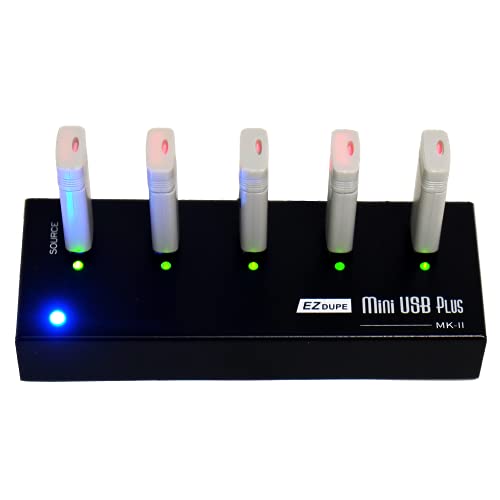
Best for Comfort – EZ Dupe 1:4 Mini USB Plus MK II
For smaller schools, mobile technicians, or limited workspaces, this compact standalone unit copies up to four USB flash drives at once. It supports USB 1.0, 2.0, and 3.0 media, offers asynchronous copying, and can run from a power bank or another USB power source.
Best For: Schools wanting a portable, space-saving duplicator for smaller batches of USB drives.
Pros:
- Compact 6-by-2.3-by-0.8-inch design weighs 12.8 ounces.
- Copies up to four USB drives simultaneously.
- Advertises copy speeds up to 45 MB/s, depending on the drives used.
- Supports asynchronous copying and power-bank operation.
Cons:
- Handles four target drives rather than seven.
- External USB storage devices need their own power source.
- Offers duplication features but does not list dedicated erasure modes in the supplied specifications.
The EZ Dupe is a practical fit when portability and simple plug-and-use operation matter more than maximum slot count or advanced sanitization controls.
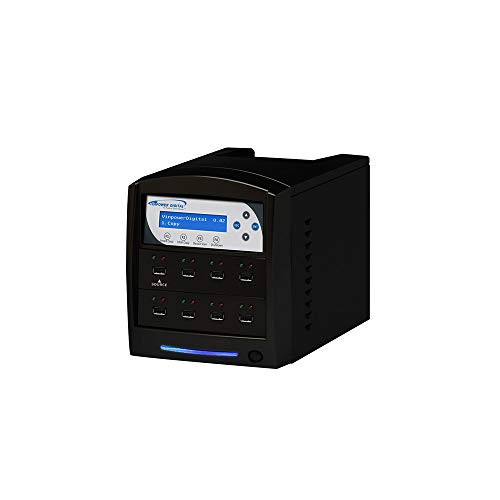
High-Capacity Pick – Vinpower Digital USBShark 7-Target Duplicator
Vinpower Digital USBShark Standalone USB Flash Drive Duplicator - 7 Targets (High Speed)
Check Price On AmazonFor schools managing larger USB rollouts, this USBShark is a high-capacity option among USB duplicators for schools. Its seven target ports, standalone design, and bit-by-bit duplication support make it suited to distributing complete USB contents without a computer.
Best For: Schools and IT teams that need to duplicate one USB device to up to seven targets while supporting varied file formats.
Pros:
- Duplicates to seven target USB devices.
- Standalone operation requires no PC.
- Supports bit-by-bit duplication and all data formats.
- Includes Smart Copy, Secure Erase, and USB Prescan for reading errors.
Cons:
- At 10 pounds, it is less convenient to move between classrooms.
- The supplied notes do not specify a warranty.
The USBShark is the strongest fit when throughput and broad duplication compatibility matter more than portability. Its prescan and secure-erase tools also add useful preparation and cleanup functions for school IT workflows.
Verification-Focused Pick – StarTech 1:5 USB Duplicator and Eraser
Schools that need both duplication and drive sanitization may prefer this StarTech unit. It handles up to five USB targets, offers multiple copy and erase modes, and provides an LCD interface for monitoring performance and drive errors.
Best For: School technicians who need to create, verify, reuse, and securely erase multiple USB drives without a computer.
Pros:
- Copies or erases up to five USB drives as a standalone device.
- Supports file-based and sector-by-sector duplication.
- Offers Quick Erase plus single-pass and 3-pass overwrite modes.
- Copy & Compare helps verify completed clones.
Cons:
- Asynchronous copying is limited to source content under 64 MB.
- External USB devices may require their own power source.
- Its listed copy speed is 1.5 GB/min, below the highest-speed option here.
With its LCD diagnostics, bad-sector scanning, and verification mode, this StarTech model is a practical choice for repeatable school IT procedures. It is especially useful when secure erasure is as important as copying.
Portable Starter Pick – BestDuplicator UB300 1:2 USB Copier
For smaller deployments, the compact UB300 offers a straightforward way to create two USB copies at once. It is one of the more accessible USB duplicators for schools, with standalone LCD operation, quick or whole-media copying, and basic media testing tools.
Best For: Schools and field technicians that usually need one source USB duplicated to two targets.
Pros:
- Duplicates one USB drive to two targets simultaneously.
- Works without Windows, Mac, or another computer.
- Offers Quick Copy and bit-for-bit Whole Media Copy.
- Includes capacity checks, speed tests, erase functions, and status LEDs.
Cons:
- Supports USB 1.1 and USB 2.0 media rather than USB 3.0.
- Two target ports limit throughput for larger school-wide deployments.
- Additional memory-card duplication requires a compatible USB card reader.
The UB300 is a sensible low-volume option when portability and simple controls matter. Its two-target capacity is best for classroom pilots, small device batches, or occasional IT work rather than mass distribution.
How We Picked the Best USB Duplicators for Schools
We focused on standalone duplicators that can copy USB media without requiring specialized software or a connected computer. The selection includes compact two-drive units, midrange models with four to seven target ports, and higher-capacity systems designed for larger deployment batches.
We also considered stated transfer speeds, support for common USB generations, standalone operation, display and menu usability, portability, and data-erasure features. For schools, practical throughput and predictable operation matter more than headline specifications alone, so buyers should verify real-world performance with the drive types and file sizes they expect to use.
Quick Comparison
- Small batches: Two- or four-target duplicators are easier to store and suit occasional classroom or office use.
- Regular IT deployment: Seven-target models provide a useful balance between capacity, footprint, and cost.
- Large batches: Ten- or 15-target systems reduce handling time when many identical drives must be prepared.
- Security-conscious workflows: Models with dedicated erase or sanitizer functions are better suited to reusable drives and sensitive data.
- Portable use: Compact standalone units work well for technicians moving between classrooms or campuses.
Key Buying Factors for USB Duplicators for Schools
Target Count and Workload
Choose the number of target ports based on your normal batch size, not an occasional peak. More ports can improve productivity, but they also increase cost and desk space. A smaller unit may be the better choice when copying only a few drives at a time.
Speed and Source Capacity
Advertised speeds are usually maximum rates under ideal conditions. Large files, many small files, slow destination drives, and USB limitations can reduce actual throughput. Check whether the duplicator supports the drive capacities and USB standards used by your school.
Copy, Compare, and Erase Functions
For repeatable deployments, useful verification or comparison functions can help identify failed copies. Secure erasure is important when drives are reassigned, returned, or used for confidential student and staff information. Confirm which sanitization standard is supported and whether it fits your policy.
Ease of Operation
An LCD or touchscreen menu can make routine tasks easier for staff who do not work with command-line tools. Look for clear status feedback, simple source-and-target workflows, and controls that reduce the chance of copying in the wrong direction.
Who Should Buy Which USB Duplicators for Schools?
Small schools and occasional users should consider a compact two- or four-target duplicator that is affordable, portable, and easy to store. School IT departments handling regular imaging or distribution tasks will usually benefit from a seven-target model with straightforward controls and erasing capability. District or campus teams preparing large batches should look at 10- or 15-target systems to reduce repeated cycles and staff time.
If secure reuse is a priority, favor a model explicitly equipped for sanitizing rather than relying only on deleting files through an operating system. Finally, standardize on a small set of compatible USB drives and test the complete workflow before a large deployment. That approach typically delivers more consistent results than choosing solely by the highest advertised copying speed.