
Choosing the right monitor can make framing, focusing, and exposure checks much faster on set. For solo shooters and small crews, field monitors with touchscreens can streamline hands-on control without adding much bulk.
Below, we focus on practical buying factors like brightness, resolution, inputs, and power options so you can match a monitor to your shooting style and budget.
Best 10 Field Monitors with Touchscreens Picks for 2026
Brightest All-Rounder
NEEWER F700 7" 2000nit Touch Monitor

- 7-inch 1080p IPS touchscreen
- 2000nit brightness with auto/manual backlight
- 4K HDMI loop in/out and LUT support
Best For: Bright outdoor shoots and users who want lots of monitoring tools
Compact Touchscreen Pick
Portkeys HD7T 7" 1000nit Monitor

- 7-inch matte display with 1000nit brightness
- Lightweight 245g body with shortcut keys
- 4K@30p HDMI input and LUT support
Best For: Portable DSLR and mirrorless rigs that need quick control
Budget Creator Monitor
FEELWORLD F5 Pro V4 6" Touchscreen

- 6-inch 1080p IPS touchscreen
- 3D LUT preview with waveform and vector
- F970 kit supports external gear
Best For: Beginners and creators building a compact on-camera setup
High-Brightness Pro Pick
VILTROX DC-X2 6" 2000nit Touch Monitor

- 6-inch IPS touchscreen with 2000nit brightness
- 4K HDMI input/loop out and custom buttons
- 3D LUT plus peaking, zebra, and waveform tools
Best For: Outdoor-focused filmmakers who want strong brightness and control
Ultra-Compact HDR Touch Monitor
Desview A5 5.5" 4K Field Monitor

- 5.5-inch IPS touchscreen with HDR-ready visuals
- Waveform, RGB histogram, and vectorscope tools
- 4K HDMI I/O plus headphone monitoring
Best For: Portable shoots needing a small touchscreen monitor
Pro Scope-Heavy Touch Monitor
Portkeys PT5 II 5" Touchscreen Monitor

- 5-inch touchscreen with slim, lightweight build
- Luma/RGB waveform, histogram, and false color tools
- 3D LUT support with 4K30P input/output
Best For: Users who want advanced scopes in a compact monitor
Lightweight Creator Pick
FEELWORLD F6 Plus V2 6" Touch Field Monitor
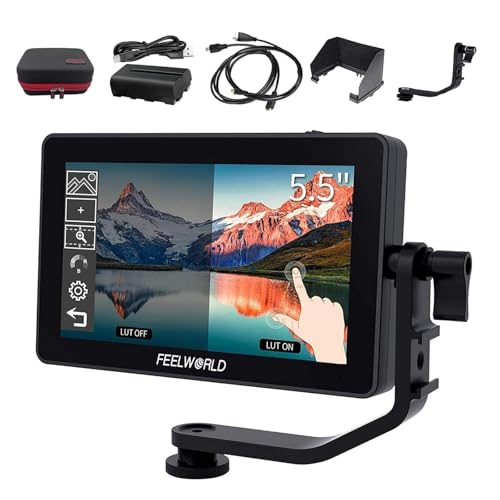
- 6-inch OCR full-fit touchscreen with easy controls
- Only 235g, suited to cameras and gimbals
- 3D LUT support with 4K HDMI in/out
Best For: Mobile creators and gimbal setups needing a light monitor
Bright OLED Pro Monitor
NEEWER F700U 7" 1200nit Touchscreen

- 7-inch OLED touchscreen with 1200 nits
- HDMI and 3G-SDI in/out support
- Peaking, false color, waveform, LUTs
Best For: Outdoor shoots and pro rigs that need a bright OLED touchscreen
Budget Touch Monitor
FEELWORLD FW759 PRO 7" 400nit IPS
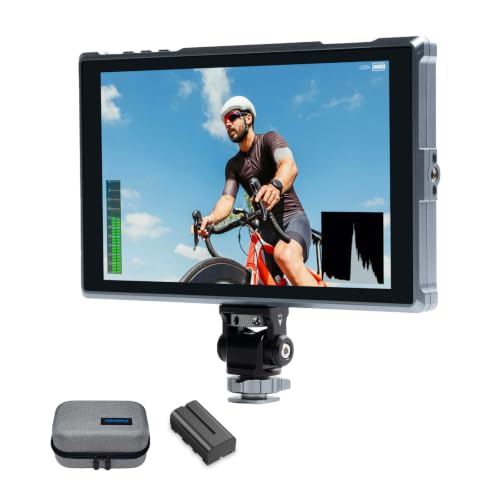
- 7-inch IPS touchscreen with 1280x800 resolution
- Lightweight 300g build for rigs and gimbals
- Histogram, zebra, focus assist, false color
Best For: Beginners and creators who want an easy portable monitor
High-Bright Creator Display
FEELWORLD F7 Plus 7" 1200nit Touchscreen

- 1200-nit IPS touchscreen with 1920x1200 resolution
- HDR monitoring with up to 32 LUT files
- Waveform, vectorscope, and histogram tools
Best For: Bright location work and creators who rely on LUTs
Brightest All-Rounder – NEEWER F700 7" 2000nit Touch Monitor
If you want a practical option in field monitors with touchscreens, the NEEWER F700 stands out for its 7-inch 1080p panel, very high 2000nit brightness, and touch-plus-button controls. It is built for use in changing light, with manual and automatic backlight adjustment, 4K HDMI loop in/out, and a full set of monitoring tools for framing and exposure checks.
Best For: Shooters who need a bright, feature-packed touchscreen monitor for daytime work and flexible camera setups.
Pros:
- 2000nit 7-inch IPS touchscreen is well suited to bright shooting conditions.
- Includes 4K HDMI loop in/out plus headphone monitoring support.
- Offers tools like waveform, vectorscope, false color, zebras, HDR, and peak focus.
- Supports NP-F batteries, Type-C charging, and DC power options.
Cons:
- Larger and heavier than some compact field monitors.
- Uses a glossy screen finish, which may be less ideal in harsh reflections.
- DC cable is not included.
The F700 is a strong choice if you want one of the more capable field monitors with touchscreens and need both brightness and advanced monitoring tools in one package.
Compact Touchscreen Pick – Portkeys HD7T 7" 1000nit Monitor
The Portkeys HD7T is a straightforward option in field monitors with touchscreens if you want a lighter rig and simple, useful monitoring features. It combines a 7-inch matte display, 1000nit brightness, 4K HDMI input, and top shortcut keys, making it a practical match for DSLR and mirrorless setups.
Best For: Shooters who want a lightweight touchscreen monitor with quick-access controls and a compact footprint.
Pros:
- 1000nit brightness and a matte screen help reduce reflections.
- Very lightweight at 245g with three-sided 1/4″-20 mounting threads.
- Includes tools such as histogram, false color, focus peaking, zoom, and anamorphic de-squeeze.
- Supports user-imported 3D LUTs and has 4K@30p HDMI input.
Cons:
- Lower resolution than some competitors at 1280×720.
- Battery is not included.
- No HDMI loop-out is listed in the supplied notes.
This is a good fit if portability matters more than ultra-high resolution, especially for rigs where a simple touchscreen and fast shortcut access are more valuable than a larger, heavier build.
Budget Creator Monitor – FEELWORLD F5 Pro V4 6" Touchscreen
For creators comparing field monitors with touchscreens, the FEELWORLD F5 Pro V4 is a compact 6-inch 1080p option built around practical on-camera use. It adds 3D LUT preview, waveform, vector, and histogram tools, plus an F970 install kit for powering add-ons in a streamlined rig.
Best For: Vloggers, beginners, and mobile creators who want a smaller touchscreen monitor with solid monitoring tools.
Pros:
- 6-inch Full HD IPS touchscreen keeps the rig compact.
- Includes 3D LUT preview plus waveform, vector, and histogram.
- F970 external power kit can help power wireless transmission gear.
- Multiple 1/4″-20 mounting points support camera rigs and handheld setups.
Cons:
- 500nit brightness is lower than brighter daylight-focused monitors.
- Smaller 6-inch screen may feel tight for some users.
- Needs a larger rig-friendly setup if you plan to use the external power kit.
The F5 Pro V4 makes sense if you want a compact, creator-friendly monitor that covers the essentials without pushing size or complexity too far.
High-Brightness Pro Pick – VILTROX DC-X2 6" 2000nit Touch Monitor
The VILTROX DC-X2 is a strong fit if you want field monitors with touchscreens that emphasize daylight visibility and a professional control layout. It pairs a 6-inch 1080p IPS panel with 2000nit brightness, 4K HDMI input/output, and a redesigned touchscreen interface with custom buttons for more precise operation.
Best For: Filmmakers who want a bright, touch-controlled monitor with advanced image tools and flexible power options.
Pros:
- 2000nit brightness and 160° viewing angle support outdoor monitoring.
- Includes 4K HDMI 1.4 input/loop out for flexible signal routing.
- Supports 3D LUTs and tools like peaking, zebra, waveform, and anti-squeeze.
- Offers multiple power methods, including NP-F, DC in, and Type-C power bank input.
Cons:
- 6-inch screen is smaller than 7-inch alternatives.
- Item weight is relatively high at 1.29 kg in the supplied specs.
- Uses a glossy screen finish, which may show reflections.
If you want a bright touchscreen monitor with a full set of monitoring tools and flexible powering, the DC-X2 is one of the more capable all-around choices here.
Ultra-Compact HDR Touch Monitor – Desview A5 5.5" 4K Field Monitor
If you want a compact option in field monitors with touchscreens, the Desview A5 is built for fast on-camera adjustments without adding much bulk. Its 5.5-inch Full HD IPS panel, 600-nit brightness, and HDR-ready display make it practical for handheld work, while the touchscreen and side knob help you change settings quickly on set.
Best For: Filmmakers and studio shooters who need a small, lightweight monitor with touchscreen controls and HDR support.
Pros:
- 5.5-inch 1920×1080 IPS screen with HDR-ready visuals and 178° viewing angles
- Touch controls plus a tactile side knob for quick menu changes
- Includes waveform, RGB histogram, and vectorscope tools for exposure and color checks
- 4K HDMI input/output and a 3.5mm headphone jack for monitoring audio
Cons:
- Battery is not included, so mobile use requires a separate NP-F550 battery
- DC adapter is also sold separately for continuous studio power
- Smaller 5.5-inch size may feel tight for users wanting a larger display
The A5 focuses on portability and core monitoring tools rather than a large screen, which makes it a sensible pick for run-and-gun shoots. If you need a lightweight touchscreen monitor with useful assist features, it covers the essentials well.
Pro Scope-Heavy Touch Monitor – Portkeys PT5 II 5" Touchscreen Monitor
The Portkeys PT5 II stands out among field monitors with touchscreens if you care about image analysis and a slim on-camera footprint. It combines a 5-inch full HD panel with touch controls, wide color gamut support, and a strong set of monitoring tools including luma and RGB waveform, histogram, false color, zebra, and 3D LUT features.
Best For: Shooters who want a lightweight touchscreen monitor with extensive exposure and color-analysis tools.
Pros:
- 5-inch 1920×1080 touchscreen with a 178° viewing angle and slim 0.28 lb design
- Built-in luma waveform, RGB waveform, and luma histogram for detailed monitoring
- 3D LUT support plus tools like false color, zebra, peaking, grids, and audio meters
- 4K30P input/output and wide color gamut support
Cons:
- Battery is not included, so you need to supply your own NP-F or LP-E6 power source
- 5-inch screen may be limiting if you prefer a larger viewing area
- Many advanced menu options can take time to learn
This is a strong choice when accurate exposure and color checks matter more than screen size. The PT5 II gives you a lot of pro-level monitoring features in a very compact form.
Lightweight Creator Pick – FEELWORLD F6 Plus V2 6" Touch Field Monitor
The FEELWORLD F6 Plus V2 is a practical option in field monitors with touchscreens for creators who want a lightweight on-camera display. Its 6-inch IPS panel, touch-driven menu, and 4K HDMI in/out make it useful for monitoring focus, exposure, and color while staying compact enough for DSLR rigs and gimbals.
Best For: Gimbal operators, DSLR shooters, and traveling creators who want a lightweight touchscreen monitor with LUT support.
Pros:
- 6-inch touchscreen with OCR full-fit glass for tap-and-swipe adjustments
- Very lightweight at 235g, making it easy to mount on cameras or gimbals
- 3D LUT loading support for log-to-REC709 preview and color calibration
- 4K HDMI in/out plus a 3.5mm headphone jack for audio monitoring
Cons:
- Battery is not included in the package shown in the notes
- Smaller display may be less comfortable for users who want a larger on-set monitor
- Feature set is solid, but not as scope-heavy as some higher-end competitors
This model is a good fit if you value portability and simple touchscreen operation over a bigger, more feature-dense display. It keeps the workflow straightforward while still covering the basics that matter on set.
Bright OLED Pro Monitor – NEEWER F700U 7" 1200nit Touchscreen
If you want field monitors with touchscreens that stay readable outdoors, the NEEWER F700U is built for demanding set work. Its 7-inch OLED panel combines 1920×1080 resolution, 1200 nits of brightness, and a 160-degree viewing angle, giving you a sharp, high-contrast image for framing and focus checks. HDMI and 3G-SDI support make it easy to use in a more professional camera setup.
Best For: Shooters who need a bright touchscreen monitor with OLED contrast, HDMI/SDI flexibility, and strong exposure tools.
Pros:
- 7-inch OLED touchscreen with 1920×1080 detail and 1200 nits brightness
- HDMI input/output plus 3G-SDI input/output for flexible monitoring
- Includes tools like peaking, false color, zebra, waveform, vectorscope, HDR, and audio levels
- Supports 15 built-in 3D LUTs and up to 64 custom LUTs via SD card
Cons:
- SD card and SDI cable are not included
- DC 12V adapter is not included
- Battery charging best practices matter, since the included NP-F batteries should be fully charged before first use
Overall, this is the most feature-rich pick here if you want a bright, touch-enabled monitor with professional signal options and extensive image analysis tools.
Budget Touch Monitor – FEELWORLD FW759 PRO 7" 400nit IPS
The FEELWORLD FW759 PRO is a straightforward choice among field monitors with touchscreens when you mainly want a larger, easier-to-read display than a camera’s built-in screen. Its 7-inch IPS panel offers 1280×800 resolution, while the touchscreen design and included sunshade help make it practical for on-the-go shooting and basic framing checks.
Best For: Beginners, vloggers, and mobile creators who want a lightweight touchscreen monitor for everyday filming.
Pros:
- 7-inch IPS touchscreen with a clearer view for composition and framing
- Includes exposure tools like histogram, zebra, focus assist, and false color
- Lightweight 300g design suits handheld rigs and gimbals
- Sunshade included for better visibility outdoors
Cons:
- 400-nit brightness is lower than daylight-bright pro monitors
- Resolution is 1280×800, not full HD
- No advanced SDI connectivity mentioned in the supplied notes
This model makes sense if you value simplicity, portability, and touch control more than premium brightness or higher-end signal features.
High-Bright Creator Display – FEELWORLD F7 Plus 7" 1200nit Touchscreen
The FEELWORLD F7 Plus is a strong option if you want field monitors with touchscreens that can handle bright locations and still give you accurate image tools. It pairs a 7-inch 1200-nit IPS display with 1920×1200 resolution and HDR monitoring, so it is aimed at shooters who want a crisp, readable on-camera display for both capture and review.
Best For: Creators who need a bright touchscreen monitor with HDR support, LUT loading, and flexible on-set mounting.
Pros:
- 1200-nit daylight-viewable IPS touchscreen with 1920×1200 resolution
- HDR monitoring plus support for up to 32 LUT files
- Includes waveform, vectorscope, histogram, and other exposure tools
- Back-mounted NP-F power supply kit can help mount accessories on set
Cons:
- Uses a 7-inch form factor, so screen size may still feel compact for some users
- Battery type is NP-F based, which may not suit every power setup
- Package is focused on HDMI workflows and does not list SDI support in the supplied notes
For creators who want a bright touchscreen with stronger resolution and LUT support, this is a well-rounded monitor for location work and compact rigs.
How We Picked These Field Monitors with Touchscreens
Our picks prioritize the features that matter most in real-world use: usable brightness outdoors, responsive touch control, reliable HDMI input/output, and monitoring tools that actually help with focus and exposure. We also considered screen size, build quality, LUT support, and power flexibility for camera rigs, gimbals, and handheld setups.
Quick Comparison: What Matters Most
In this category, the biggest tradeoffs are usually brightness, portability, and toolset depth. Higher-nit models are easier to see in sunlit environments, while smaller screens are lighter and more travel-friendly. If you need wireless transmission or external power expansion, look for models with accessory-friendly mounting and power options. If your work is mostly indoors, a lower-brightness monitor can still be a smart value choice.
Key Buying Factors for Field Monitors with Touchscreens
Brightness and Visibility
Brightness is one of the most important specs. Around 1000 nits is a strong baseline for mixed indoor/outdoor shooting, while 1200 to 2000 nits is better for harsh daylight. If you often work outside, prioritize visibility over extra features you may not use.
Screen Size and Resolution
Seven-inch monitors are popular because they balance detail and portability, while 5- to 6-inch models suit compact rigs better. Full HD resolution is common and usually sufficient for checking focus, though the most important part is how readable the image is in your shooting conditions.
Touch Tools and Monitoring Aids
Good touch controls should make it easy to access peaking, false color, waveform, zoom, LUTs, and aspect guides. The best Field Monitors with Touchscreens reduce menu digging and speed up adjustments when you are working alone.
Inputs, Outputs, and Power
Check for 4K HDMI input/output if you need passthrough or want to keep your rig flexible. Battery plate support, USB-C or DC power options, and compatibility with common batteries can also make a big difference on long shoot days.
Who Should Buy Which Field Monitors with Touchscreens?
If you shoot outdoors often, choose a brighter 1200-nit-plus monitor. If you need the lightest possible setup, go smaller and keep the feature set simple. Filmmakers who rely on color management and precise focus should look for 3D LUT support plus strong exposure tools. For DSLR and mirrorless users building a practical rig, a balanced touchscreen monitor with good brightness and HDMI versatility is usually the best place to start.