
Choosing the right monitor can make framing, focusing, and exposure control much easier on any shoot. The best field monitors give you a clearer view than a camera screen and help you work faster in changing light.
In this roundup, we focused on practical features that matter most to solo creators, indie filmmakers, and run-and-gun shooters.
Best 10 Field Monitors Picks for 2026
Entry-Level Field Monitor
FEELWORLD FW759 PRO 7" Touchscreen

- 7-inch IPS display with 1280x800 resolution
- Focus, zebra, histogram, and false color tools
- Lightweight 300g build with included sunshade
Best For: Beginners and vloggers who want a simple, practical monitoring upgrade
High-Brightness Compact Monitor
VILTROX 5.5" 1200-Nit Touchscreen

- 1200-nit brightness for daylight viewing
- Full-HD 1920 x 1080 touchscreen panel
- Waveform, vectorscope, and custom 3D LUT support
Best For: Creators who need a bright compact monitor with pro-level monitoring tools
Budget Field Monitor

- 7-inch IPS screen with 1000-nit brightness
- Histogram, false color, peaking, and zoom tools
- Very light 278g body with flexible mounting
Best For: Mobile and DSLR shooters who want a lightweight, daylight-viewable monitor
Ultra-Bright Pro Monitor
FEELWORLD F5 Prox 5.5" 1600-Nit

- 1600-nit display for strong outdoor visibility
- Focus peaking, waveform, histogram, and false color
- Compact size works on rigs, cages, and gimbals
Best For: Filmmakers who need a very bright compact monitor for outdoor shooting
Budget Field Monitoring

- 7-inch IPS display with 1280 x 800 resolution
- 450-nit brightness plus included sunshade
- Focus peaking, safe frames, and image freeze tools
Best For: DSLR and camcorder users wanting a simple external monitor
Starter On-Camera Monitor

- 7-inch 1280 x 800 IPS screen with 4K HDMI input
- Focus peaking, false color, histogram, and audio meter
- Slim 17mm body and 300g portable design
Best For: Vloggers and beginners who want a lightweight HDMI monitor
Pro Bright Field Monitor
NEEWER F700 7" 2000nit Touchscreen

- 2000-nit 1080p IPS touchscreen for bright conditions
- Waveform, vectorscope, zebras, HDR, and LUT support
- NP-F, DC, and Type-C power options
Best For: Creators who need a bright, feature-rich monitor for serious video work
Portable Brightness Pick
Osee T5+ 5.5" 1000nit Camera Monitor

- 1000nit display for outdoor visibility
- Custom false color and exposure tools
- 8 MySets for quick workflow changes
Best For: Outdoor shooters who need a bright, compact monitor
Budget Studio Monitor
FEELWORLD S55 V3 6" HDMI Field Monitor

- 6-inch Full HD IPS display
- Waveform, vectorscope, and LUT support
- Sun hood and flexible power options
Best For: Beginners and indoor creators needing a simple external monitor
Touchscreen Value Pick
FEELWORLD FW759 PRO 7" Touch Field Monitor
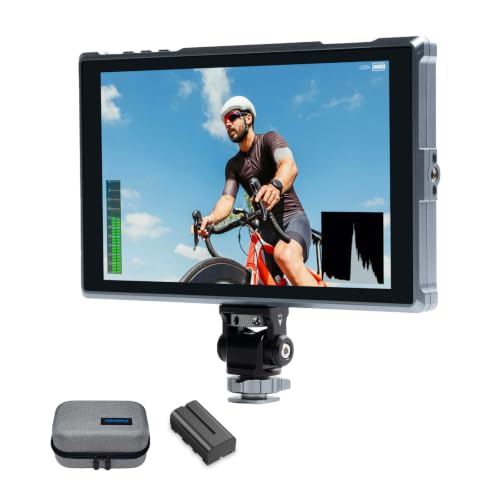
- 7-inch touchscreen for easier control
- Lightweight 300g design for rigs and gimbals
- Histogram, zebra, focus assist, and false color
Best For: Creators wanting a portable touchscreen monitor for everyday shooting
Entry-Level Field Monitor – FEELWORLD FW759 PRO 7" Touchscreen
If you want a practical field monitor for clearer framing, the FEELWORLD FW759 PRO gives you a 7-inch 1280×800 IPS screen that’s much easier to work with than a camera’s built-in display. It adds useful exposure and focus tools, plus a lightweight body that suits handheld rigs, gimbals, and simple run-and-gun setups.
Best For: Beginners, vloggers, and creators who want a straightforward on-camera monitoring upgrade.
Pros:
- 7-inch IPS display with 1280×800 resolution for a larger viewing area.
- Built-in histogram, zebra, focus assist, and false color for shooting support.
- Light 300g design works well on handheld rigs and gimbals.
- Includes sunshade and multiple cables plus batteries in the kit.
Cons:
- 400-nit brightness is less suited to very bright daylight than higher-nit options.
- Resolution is lower than full-HD field monitors.
- Single HDMI port limits connectivity flexibility.
This is a solid value pick if your priority is usable monitoring tools, simple setup, and a larger screen without jumping to a more expensive high-brightness model.
High-Brightness Compact Monitor – VILTROX 5.5" 1200-Nit Touchscreen
The VILTROX 5.5-inch monitor is built for creators who need a compact field monitor with strong outdoor visibility. Its 1200-nit panel, 1080p resolution, and wide set of video tools make it a flexible choice for exposure checks, framing, and LUT-based previewing on small rigs.
Best For: Shooters who want a bright, compact monitor with advanced monitoring tools and LUT support.
Pros:
- 1200-nit brightness helps the screen stay visible in intense lighting.
- 1080p panel with 1920 x 1080 resolution and 1200:1 contrast.
- Includes waveform, vectorscope, histogram, focus peaking, zebra, and false color.
- Supports custom 3D LUTs and anamorphic de-squeeze monitoring.
Cons:
- Smaller 5.5-inch screen may feel tight for users who prefer larger displays.
- Only one HDMI port is listed.
- Glossy screen finish may be less ideal than matte in some lighting setups.
Overall, this is a strong pick if you want a small monitor that still delivers serious monitoring tools and excellent daylight usability.
Budget Field Monitor – Portkeys HD7H 7" 1000-Nit
The Portkeys HD7H is a practical field monitor for shooters who want a larger 7-inch screen and daylight-viewable brightness without a bulky rig. It includes essential exposure and focus tools, plus audio output and flexible mounting points, making it a versatile option for DSLR and mirrorless setups.
Best For: Content creators who want a lightweight 7-inch monitor for flexible studio or mobile use.
Pros:
- 1000-nit brightness and matte anti-glare screen help outdoors.
- 7-inch IPS panel with 1280 x 720 native resolution.
- Includes histogram, false color, focus peaking, zoom, and anamorphic de-squeeze.
- Light 278g build with 1/4-inch mounting threads on three sides.
Cons:
- Native resolution is lower than full-HD models.
- Battery is not included.
- Only one HDMI port is listed.
If you want a light, flexible monitor with the core tools most shooters need, the HD7H is a very workable all-around choice.
Ultra-Bright Pro Monitor – FEELWORLD F5 Prox 5.5" 1600-Nit
The FEELWORLD F5 Prox is aimed at creators who need a bright field monitor that stays usable outdoors. With a 1600-nit display, focus and exposure tools, and LUT preview support, it’s built to help you monitor framing and color more confidently during professional shoots.
Best For: Filmmakers, vloggers, and photographers who need very high brightness in a compact monitor.
Pros:
- 1600-nit brightness is designed for outdoor visibility.
- Includes focus peaking, waveform, histogram, false color, and LUT preview.
- Compact 5.5-inch size suits rigs, cages, and gimbals.
- Compatible with DSLR, mirrorless, and cinema cameras.
Cons:
- Smaller display may be less comfortable for users who prefer 7-inch monitors.
- Single-screen compact format offers less viewing area than larger field monitors.
- Documentation in the notes is lighter than the other models here.
For bright-location shooting where screen visibility matters most, this monitor stands out as one of the most capable compact options in the group.
Budget Field Monitoring – NEEWER F100 7" 1280×800 IPS
The NEEWER F100 is a practical field monitor for creators who want a bigger, easier-to-read display than a camera LCD without adding much bulk. Its 7-inch IPS panel, 1280 x 800 resolution, 450-nit brightness, and included sunshade make it a straightforward option for everyday video shooting and outdoor use.
Best For: DSLR and camcorder users who want a compact external monitor with helpful framing and focus tools.
Pros:
- 7-inch IPS screen with 1280 x 800 resolution for a clearer view than most built-in displays
- Includes focus peaking, check field, pixel-to-pixel, safe frames, image flip, and image freeze tools
- Sunshade and 450-nit brightness help visibility when shooting outdoors
- Works with DSLR cameras, camcorders, stabilizers, and camera cranes
Cons:
- Lower brightness than newer high-nit field monitors
- Feature set is practical, but not as advanced as premium models
- Best suited to basic monitoring rather than high-end production workflows
Overall, the F100 makes sense if you need a simple, affordable field monitor with the core tools most shooters actually use. It focuses on visibility, compatibility, and essential monitoring aids rather than premium extras.
Starter On-Camera Monitor – FEELWORLD FW759 7" 400nit IPS
The FEELWORLD FW759 is aimed at creators who want a larger, more usable field monitor than a camera’s built-in screen without overcomplicating the setup. Its 7-inch 1280 x 800 IPS panel, 400-nit brightness, 4K HDMI input support, and slim 17mm body make it a sensible pick for beginner-friendly shoots.
Best For: Vloggers, social media creators, and beginners who want a lightweight HDMI monitor for framing and focus checks.
Pros:
- 7-inch IPS screen gives a bigger, clearer view for framing and composition
- Includes focus peaking, histogram, false color, overexposure warning, zoom, safe frame, and audio meter
- Lightweight 300g design with a slim 17mm thickness
- Supports 4K HDMI input and works with DSLR, mirrorless, camcorders, gimbals, and tripods
Cons:
- 400-nit brightness is better for indoor use than harsh sunlight
- Not as feature-heavy as higher-end professional field monitors
- Designed more for basic confidence and monitoring than advanced production control
For creators building a simple video rig, the FW759 covers the essentials well. It gives you the tools to check focus and exposure more accurately, while staying compact enough for travel, interviews, and everyday content work.
Pro Bright Field Monitor – NEEWER F700 7" 2000nit Touchscreen
The NEEWER F700 is built for shooters who need a serious field monitor with stronger visibility and more advanced tools. Its 7-inch 1920 x 1080 IPS touchscreen, 2000-nit brightness, 4K HDMI loop in/out, and built-in cooling make it a more capable option for demanding setups and bright environments.
Best For: Video creators who want a bright touchscreen monitor with professional exposure tools and LUT support.
Pros:
- Very bright 2000-nit 1080p touchscreen for better outdoor visibility
- Offers waveform, vectorscope, zebras, false color, histogram, HDR, and peak focus tools
- Supports 15 preloaded 3D LUTs and up to 60 custom 3D LUT uploads
- Flexible power options include NP-F batteries, DC, and Type-C charging
Cons:
- More advanced than basic shooters may need
- Heavier with batteries than simpler 7-inch monitors
- Battery and power setup is more involved than entry-level models
If you want a field monitor that can handle bright light and more technical exposure work, the F700 stands out quickly. It combines a high-bright touchscreen, strong monitoring tools, and flexible power support in one rugged on-camera display.
Portable Brightness Pick – Osee T5+ 5.5" 1000nit Camera Monitor
The Osee T5+ is a practical choice for field monitors when you need a brighter screen and stronger exposure tools on location. Its 1000nit panel is built for outdoor use, while the built-in false color, waveform, histogram, vector, zebra, and 3D LUT support help you make faster decisions in the field.
Best For: Outdoor shooters who want a bright monitor with customizable exposure tools and fast workflow presets.
Pros:
- 1000nit brightness improves visibility for outdoor filming without always needing a sun hood.
- Custom false color tools and camera-model presets can reduce repeated setup work.
- 8 MySets let you preload monitoring configurations for quicker on-set changes.
- Supports 4K HDMI input, LOG/HDR preview, and user LUT uploads.
Cons:
- 5.5-inch screen is smaller than some other field monitors.
- Battery is not included.
Overall, the T5+ stands out if brightness and workflow speed matter more than screen size. It leans toward creators who want more control over exposure and preview tools in a compact rig.
Budget Studio Monitor – FEELWORLD S55 V3 6" HDMI Field Monitor
The FEELWORLD S55 V3 is a straightforward field monitor for creators who want a larger external screen and dependable monitoring tools. It combines a Full HD IPS display with waveform, vectorscope, RGB histogram, focus assist, false color, and 3D LUT support, making it useful for checking exposure and focus while shooting.
Best For: Beginners and indoor creators who want a reliable HDMI monitor for framing, focus, and exposure checks.
Pros:
- 6-inch 1920×1080 IPS screen gives you a clearer external view than a camera display.
- Includes waveform, vectorscope, RGB histogram, focus assist, false color, and 3D LUT support.
- Comes with a sun hood to help visibility when shooting outdoors.
- Offers 4K HDMI input/output and multiple mounting and power options.
Cons:
- 500nit brightness is best suited to indoor or controlled shooting setups.
- Not as bright as higher-output field monitors for harsh daylight use.
If you mainly shoot in studios, indoors, or mixed setups, the S55 V3 covers the core monitoring essentials without adding complexity. It’s a solid practical step up for creators who want better framing and exposure confidence.
Touchscreen Value Pick – FEELWORLD FW759 PRO 7" Touch Field Monitor
The FEELWORLD FW759 PRO is a larger touchscreen option for field monitors users who want a simple way to replace a small camera screen. Its 7-inch IPS display, combined with histogram, zebra, focus assist, and false color, gives you the core tools needed to judge framing and exposure more easily during production.
Best For: Creators who want a lightweight 7-inch touchscreen monitor for handheld rigs, gimbals, and general video work.
Pros:
- 7-inch touchscreen design makes it easier to operate than a basic camera display.
- 1280×800 IPS panel provides a larger view for composition and framing.
- Includes histogram, zebra, focus assist, and false color for monitoring basics.
- 300g ultra-lightweight build is friendly for handheld and gimbal setups.
Cons:
- 400nit brightness is more modest than some brighter field monitors.
- 1280×800 resolution is lower than Full HD options.
The FW759 PRO is best viewed as a practical, lightweight monitoring aid rather than a high-brightness flagship. For creators prioritizing screen size, portability, and touchscreen convenience, it covers the essentials well.
How We Picked the Best Field Monitors
We prioritized Field Monitors that offer a useful mix of brightness, screen size, image clarity, and monitoring tools. We also favored models with 4K HDMI support, touch controls, false color, focus peaking, and workflow-friendly extras like LUT support and loop-through connectivity.
Because field use can mean anything from handheld vlogging to outdoor filmmaking, we looked for options that balance portability with visibility and reliable operation.
Quick Comparison
Smaller 5.5-inch models are usually the easiest to mount on compact rigs and gimbals, while 7-inch monitors give you a larger image for critical focus and composition. Brightness matters just as much: lower-nit screens can work indoors, but high-nit models are better for daylight shooting.
Touchscreen controls can speed up adjustments, though physical shortcut keys may be preferable when you need fast tactile access. If you shoot in mixed lighting or want consistent color decisions, features like HDR preview, 3D LUT support, and false color are especially valuable.
Key Buying Factors for Field Monitors
Brightness and Visibility
For indoor studio work, moderate brightness may be enough. For outdoor or daylight use, look for a brighter screen so you can actually judge exposure and framing without constant shade.
Screen Size and Resolution
A 7-inch display gives more room for detail, while smaller screens are lighter and easier to integrate into mobile rigs. Resolution is important too, especially if you want a sharper image for focus checking.
Monitoring Tools
Good Field Monitors should help you expose and focus accurately. Common tools include peaking, zebra, waveform, false color, and LUT preview. Pick the tools you’ll use regularly rather than paying for extras you won’t touch.
Connectivity and Workflow
Make sure the monitor supports the HDMI format your camera uses and consider loop-out if you need to feed another display or recorder. A flexible power setup also matters for longer shoots.
Who Should Buy Which Field Monitors?
If you need a budget-friendly monitor for indoor shooting or simple framing, a basic 5.5- to 7-inch option may be enough. If you film outdoors or on fast-moving sets, prioritize a brighter screen with touch controls and strong assist tools.
Creators who want a streamlined rig should look at lightweight Field Monitors with straightforward menus, while filmmakers who rely on precise exposure and color checks should lean toward models with LUT support, false color, and higher-resolution panels.