
Sharp insect macro images often depend on camera movement measured in millimeters. The right focusing rail lets you position a camera precisely, refine focus for stacking, and make repeatable adjustments without disturbing a delicate subject.
We compared 10 macro rails across adjustment design, mounting compatibility, travel, and handling features to help you choose a practical setup for field and studio insect photography.
Best 10 Camera Macro Rails for Insect Photography Picks for 2026
Best All-Around 4-Way Rail
NEEWER 4-Way Macro Focusing Rail

- Four-direction positioning
- Numeric scales and large knobs
- Supports up to 2.5 kg
Best For: Flexible field macro and insect photography setups
Best for Focus Stacking
SWEBO S102082 2-Accuracy Macro Slide Rail

- 0.04 mm and 0.01 mm rails
- Arca-Swiss-compatible clamp
- 577 g maximum recommendation
Best For: Fine-adjustment focus stacking with lighter setups
Best Heavy-Duty Option
Koolehaoda 115mm Macro Focusing Rail

- 10 kg stated load capacity
- 115 mm worm-gear adjustment
- Arca/RRS-compatible base
Best For: Heavy DSLR and macro lens setups
Best Lightweight Worm-Drive Rail

- 115 mm front-to-back travel
- 4 mm stroke per full screw rotation
- Arca-type and tripod mounting
Best For: Portable macro and focus-stacking setups
Precision Pick
SIRUI MS18 Macro Focusing Rail

- Fine side-knob and quick-adjustment controls
- 360° rotating head with Arca-compatible plate
- Stackable design enables four-way adjustment
Best For: Precise, modular close-up and insect photography setups
Stable All-Rounder

- Smooth 14 mm-per-turn rack adjustment
- Damped 360° module with level and locking knob
- Removable feet support stable tabletop shooting
Best For: Larger camera setups and controlled macro composition
Budget 4-Way Option
Generic 4-Way Macro Focusing Rail

- Forward, backward, left, and right movement
- Locking knobs help hold focus position
- Lightweight 330 g design
Best For: Smaller camera setups needing basic four-way adjustment
Best with Extra Features
NiSi NM-180S Macro Focusing Rail

- 1.25mm movement per rotation with a 160mm range
- 360-degree rotating clamp for flexible composition
- Arca-compatible, durable CNC-machined aluminum design
Best For: Precise insect and close-up shooting with flexible tripod mounting
Stacking Specialist
Haoge MFR-180 Macro Focusing Rail
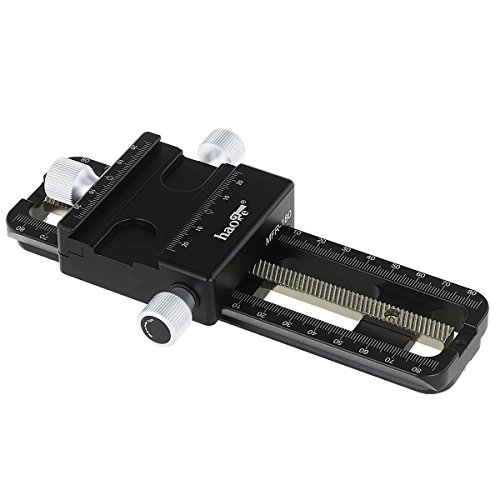
- Built for incremental macro camera alignment
- Supports focus stacking and nodal-slide use
- Integrated Arca-type clamp and dovetail groove
Best For: Lightweight macro setups and focus-stacking workflows
Fine-Control Choice

- 0.05mm micrometer adjustment for precise positioning
- Quick adjustment with a 160mm travel range
- Detachable feet and integrated Arca quick-release plate
Best For: Fast, highly precise close-up and focus-stacking adjustments
Best All-Around 4-Way Rail – NEEWER 4-Way Macro Focusing Rail
For photographers comparing camera macro rails for insect photography, the NEEWER 4-Way Macro Focusing Rail offers flexible positioning in a portable aluminum design. Its four-direction movement and numeric scales help with careful camera placement during close-up work.
Best For: Insect photographers who need both forward-backward and side-to-side adjustment for field macro shooting.
Pros:
- Four-way movement supports left, right, forward, and backward adjustments.
- Large screw knobs and numeric scales assist with repeatable positioning.
- Quick release plate, silicone camera pad, and two tripod-connection methods add convenience.
- Supports cameras up to 2.5 kg while weighing 570 g.
Cons:
- Requires tightening the horizontal or vertical adjustment knob when moving along the other axis.
- It is not water resistant, so outdoor users should protect it from moisture.
The NEEWER is a versatile choice when an insect subject or composition calls for more than a single-axis adjustment. Its weight and 2.5 kg capacity balance portability with support for many DSLR and mirrorless setups.
Best for Focus Stacking – SWEBO S102082 2-Accuracy Macro Slide Rail
Swebo S102082 2-Accuracy Macro Focusing Slide Rail,Focus Stacking,Insect Macro Photography
Check Price On AmazonThe SWEBO S102082 is aimed at photographers choosing camera macro rails for insect photography with focus stacking in mind. It includes two accuracy slide rails rated at 0.04 mm and 0.01 mm, giving close-up shooters fine control over camera movement.
Best For: Focus-stacking work that benefits from very fine incremental adjustments and Arca-Swiss compatibility.
Pros:
- Includes 0.04 mm and 0.01 mm accuracy slide rails.
- Uses three bearings, including two miniature thrust bearings.
- Arca-Swiss-compatible quick release clamp connects with compatible tripod heads.
- Provides five 1/4-inch screw holes and a large knurled knob with crank combination.
Cons:
- Its listed maximum weight recommendation is 577 g, limiting heavier camera-and-lens combinations.
- The supplied notes do not specify a four-way movement system.
This rail stands out for precision-focused macro workflows rather than maximum load capacity. Check your complete camera and lens weight before choosing it for field insect photography.
Best Heavy-Duty Option – Koolehaoda 115mm Macro Focusing Rail
For photographers evaluating camera macro rails for insect photography with heavier DSLR or lens setups, the Koolehaoda 115mm Macro Focusing Rail combines metal construction with a 10 kg stated maximum load. Its worm-gear adjustment and dual-sided millimeter scales support controlled changes in camera-to-subject distance.
Best For: Heavy macro camera and lens combinations using Arca-Swiss or RRS-style support equipment.
Pros:
- Offers a 115 mm adjustment range for precise focusing distance changes.
- Worm-gear drive and two control knobs provide manual regulation.
- Metal construction is designed for durability and abrasion resistance.
- Supports up to 10 kg and includes an Arca-type base plate.
Cons:
- At 300 g, it is lighter than some rails but still adds another support component to a field kit.
- The design provides a single 115 mm adjustment range rather than the four-way movement listed for some alternatives.
The Koolehaoda is a strong fit when load capacity and compatibility matter more than multi-axis movement. Its worm drive is particularly useful for deliberate camera-to-subject adjustments around skittish insects.
Best Lightweight Worm-Drive Rail – Haoge FM-160 Macro Rail
The Haoge FM-160 is a practical option for photographers seeking camera macro rails for insect photography without a bulky field accessory. Its 115 mm front-to-back travel, fine adjustment screw, and 1 mm reference scales are suited to close-up alignment and focus stacking.
Best For: Nature photographers who want a portable, fine-adjustment rail for macro and focus-stacking work.
Pros:
- Provides 115 mm of front-to-back movement controlled by an adjustment knob.
- Each full fine-screw rotation produces a 4 mm stroke for incremental positioning.
- Includes 1 mm laser-engraved scales on both sides and two damping-control screws.
- Arca-type clamp, dovetail groove, and 1/4-inch-20 tripod threads support flexible mounting.
Cons:
- Its listed maximum weight recommendation is 14.1 ounces, so it is intended for lighter setups.
- The rail is not water resistant for unprotected wet-weather use.
At approximately 400 g, the FM-160 is easy to include in a nature-photography bag. It is best matched with a lighter camera setup where precise front-to-back control is the priority.
Precision Pick – SIRUI MS18 Macro Focusing Rail
The SIRUI MS18 is a strong choice among camera macro rails for insect photography when precise positioning and flexible camera angles matter. Its fine-adjustment side knob, quick adjustment button, and Arca-compatible mounting system support controlled close-up work.
Best For: Photographers who want precise focus adjustments, angle control, and the option to build a four-way macro setup.
Pros:
- Fine adjustment with a tactile side knob and quick adjustment button.
- 360-degree rotating head supports flexible shooting angles.
- Two rails can be stacked for four-way camera adjustment.
- Removable feet allow tabletop or tripod-mounted use.
Cons:
- It is not water resistant, which may require care during outdoor insect photography.
- The 440 g weight may be more than a basic rail setup.
With a stated maximum load recommendation of 10 kg and several mounting options, the MS18 is well suited to photographers who value adjustment range and a modular setup.
Stable All-Rounder – Fotopro FT-100 PRO Macro Rail
The Fotopro FT-100 PRO offers a sturdy option among camera macro rails for insect photography, combining a damped 360-degree top module with smooth rack adjustment. Its removable feet also make it practical for stable desktop shooting without a tripod.
Best For: Macro photographers using larger DSLR or mirrorless cameras who want smooth adjustment, broad camera compatibility, and stable tabletop support.
Pros:
- CNC-machined aluminum construction, stainless-steel hardware, and durable copper sliding parts.
- 14 mm of movement per knob turn supports quick, smooth focusing changes.
- 360-degree rotating module, level, damping, and locking knob aid composition and stability.
- Removable feet and two bottom 1/4-inch interfaces support flexible setups.
Cons:
- It is not water resistant.
- The 7.4-inch rail may be less compact than a shorter macro slider.
The FT-100 PRO stands out for its combination of smooth controls, safety features, and a stated 17.6-pound maximum weight recommendation, making it a capable choice for heavier camera combinations.
Budget 4-Way Option – Generic 4-Way Macro Focusing Rail
This 4-way macro focusing rail is a straightforward option among camera macro rails for insect photography, providing forward, backward, left, and right movement. Locking knobs and rack-and-pinion adjustment help keep the camera steady while refining working distance.
Best For: Macro photographers seeking basic four-direction positioning for compatible cameras with a standard 1/4-inch screw hole.
Pros:
- Two rails provide four-direction sliding adjustment.
- Locking knobs are designed to hold the camera securely during focusing.
- Smooth rack-and-pinion movement supports fine distance changes.
Cons:
- The stated maximum weight recommendation is limited to 415 g.
- It is made of plastic rather than the metal construction listed for the other rails.
- It lacks the rotating head and additional mounting features described for the other options.
At 330 g, this rail is relatively light, but its low stated load limit makes it best suited to smaller camera configurations rather than heavier DSLR or lens combinations.
Best with Extra Features – NiSi NM-180S Macro Focusing Rail
For photographers comparing camera macro rails for insect photography, the NiSi NM-180S offers controlled positioning without sacrificing mounting flexibility. Its 160mm adjustment range and 1.25mm movement per rotation are useful when fine-tuning focus on a small, moving subject.
Best For: Insect photographers who want precise macro positioning, broad tripod compatibility, and easy camera-orientation changes.
Pros:
- Provides 1.25mm movements per rotation across a 160mm adjustment range.
- Includes a 360-degree rotating clamp for changing camera orientation without removing the mount.
- Supports Arca-style mounting, 1/4-inch and 3/8-inch screw holes, and detachable feet.
- CNC-machined aluminum construction has a corrosion-resistant, scratch-resistant finish.
Cons:
- Its many mounting options may be more than casual close-up shooters need.
- The supplied notes do not specify water resistance.
The NiSi stands out as a versatile choice for field macro work, especially when you need repeatable adjustments and flexible positioning around a tripod setup.
Stacking Specialist – Haoge MFR-180 Macro Focusing Rail
The Haoge MFR-180 is a straightforward option among camera macro rails for insect photography, with a design aimed at incremental camera alignment. Its integrated Arca-type clamp and dovetail groove also make it suitable for compatible heads and accessories.
Best For: Macro photographers focused on close-up alignment, focus stacking, or occasional nodal-slide use.
Pros:
- Designed for precise incremental adjustments in close-up and macro photography.
- Supports focus stacking and can function as a nodal slide for panorama shooting.
- Includes an integrated Arca-type quick-release clamp and Arca-type dovetail groove.
- Has a stated maximum weight recommendation of 14.1 ounces.
Cons:
- The maximum recommended load is relatively limited compared with heavier camera setups.
- It is not water resistant according to the supplied details.
- The notes do not specify the rail’s movement range or adjustment increment.
Choose the MFR-180 when Arca compatibility and focus-stacking support matter most, but check your camera-and-lens weight before pairing it with a larger macro rig.
Fine-Control Choice – AstrHori AH-MGA170 Macro Rail
For demanding camera macro rails for insect photography, the AstrHori AH-MGA170 combines quick repositioning with very fine control. A 160mm range, 2mm movement per rotation, and stated 0.05mm micrometer adjustments help you refine composition and focus at close distances.
Best For: Macro and insect photographers who want rapid coarse adjustments followed by highly precise positioning.
Pros:
- Offers a quick-adjustment feature with 2mm movements per rotation and a 160mm range.
- Provides stated micrometer adjustments as fine as 0.05mm for close-up positioning.
- Includes detachable feet, an integrated Arca quick-release plate, and 1/4-inch and 3/8-inch screw holes.
- Uses an alloy 6061 body and stainless steel 304 screw for a durable all-metal construction.
Cons:
- It is not water resistant according to the supplied details.
- The feature set may be unnecessary for photographers who only need basic macro positioning.
- Although the listed maximum weight recommendation is 10kg, actual setup compatibility should still be checked.
The AH-MGA170 is the strongest fit here for photographers who value both speed and micro-adjustment control, particularly for careful focus-stacking or highly detailed insect subjects.
How We Picked These Camera Macro Rails for Insect Photography
We focused on the features that matter most when photographing insects at high magnification: precise forward-and-back movement, stable camera support, useful travel, and compatibility with common tripod systems. The selection includes four-way rails for broader positioning, rack-and-pinion and worm-drive designs for controlled adjustments, and compact sliders suited to field kits.
We also considered quick-release plates, Arca-Swiss compatibility, standard 1/4-inch mounting threads, construction materials, and whether a rail can support focus-stacking workflows. Because insect photography often involves low working distances and narrow depth of field, smooth, incremental control received more weight than maximum size alone.
Quick Comparison
- Best for all-around adjustment: Four-way rails provide front-to-back and side-to-side positioning, useful for composing a subject without moving the tripod.
- Best for precise stacking: Worm-drive and geared rails generally offer finer, more repeatable movement than simple friction sliders.
- Best for compact kits: Shorter rails reduce weight and pack more easily for outdoor insect photography.
- Best for Arca-based setups: Models with Arca-compatible plates or clamps can integrate quickly with compatible tripod heads and clamps.
- Best for larger cameras or lenses: Longer aluminum rails and robust mounting hardware can provide better balance and positioning range.
Key Buying Factors for Camera Macro Rails for Insect Photography
Adjustment Precision
Look for a geared, worm-drive, or rack-style mechanism when you need controlled focus-stacking increments. A basic slider can work for composition, but it may be less consistent at extreme magnification.
Travel and Direction of Movement
Longer travel gives you more room to adjust subject framing and focus distance. A four-way design adds lateral movement, while a single-axis rail is usually simpler, lighter, and easier to use with a stable tripod.
Mounting Compatibility
Check the rail’s camera screw, tripod thread, quick-release plate, and clamp dimensions. Standard 1/4-inch threads are broadly useful, while Arca-compatible hardware can speed up setup if your tripod head already uses that system.
Stability and Balance
At macro magnifications, small vibrations become obvious. Prefer a rigid metal rail with a secure locking mechanism, and make sure its load capacity suits your camera, macro lens, flash bracket, and other accessories.
Who Should Buy Which Camera Macro Rails for Insect Photography?
Choose a four-way rail if you frequently recompose live insects or need lateral control without repositioning the tripod. Choose a worm-drive or geared model if focus stacking and repeatable micro-adjustments are your priority. A compact rail is the better choice for handheld field kits and lightweight mirrorless systems, while a longer, sturdier rail suits studio work, heavier DSLRs, and larger macro lenses. If your existing support system uses Arca-Swiss hardware, prioritize a compatible quick-release design to reduce setup time.