
Modern conference rooms often combine SDI cameras, HDMI displays, presentation systems, and streaming hardware. The right converter can bridge those formats while preserving signal quality and simplifying installation.
This roundup compares 10 practical options for converting, scaling, distributing, and embedding or de-embedding audio in professional meeting spaces. Use the guide below to match each converter type to your room’s equipment and workflow.
Best 10 Sdi Converters for Conference Rooms Picks for 2026
Flexible Signal Bridging

- Bidirectional HDMI and SDI conversion
- Automatic active-input selection
- Supports 3G Level A and B
Best For: Mixed HDMI/SDI conference-room systems
Format Conversion Control

- Up, down, and cross-converts SD/HD
- Provides HDMI and SDI I/O
- Includes reference re-sync input
Best For: Conference rooms with varied SD and HD formats
Wall-Mountable Scaling Hub

- Converts HDMI and SDI signals
- Adds scaling and frame-rate conversion
- Provides two 3G-SDI outputs
Best For: Fixed installations needing scaling and SDI distribution
Multi-Display SDI Distribution

- Splits one SDI feed to eight outputs
- Supports SD, HD, and 3G-SDI
- Includes re-clocking and redundant input
Best For: Multi-endpoint SDI conference-room distribution
Flexible Signal Hub

- Accepts audio, HDMI, SDI, and VGA inputs
- Outputs HDMI and 3G/HD/SD SDI
- Optional rackmount installation
Best For: Mixed-format conference room systems
Scaled SDI Monitoring

- Converts SDI to HDMI
- Includes display and scaler
- Backed by a stated 2-year warranty
Best For: Single-monitor SDI-to-HDMI connections
Multi-Display Distribution

- Four SDI and four HDMI outputs
- Cross-converts SDI and HDMI up to 1080p60
- Adds SDI equalization and re-clocking
Best For: Multi-display conference room distribution
Compact Conference Room Pick

- HDMI input with two SDI outputs
- 2.7-inch display and audio meter
- Mounting brackets and 2-year warranty
Best For: Simple HDMI-to-SDI room systems needing local monitoring
SDI Display Bridge
Anber-Tech SDI-to-HDMI Converter
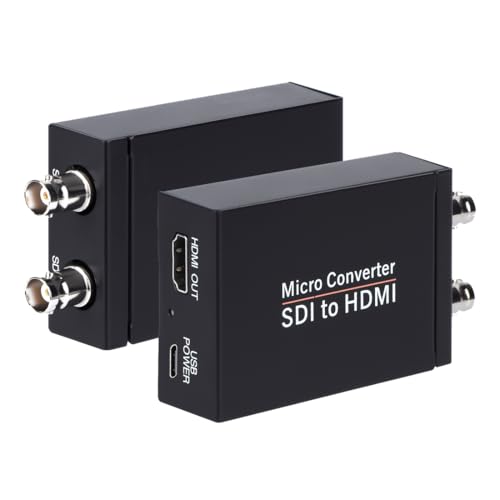
- Supports 3G, HD, and SD-SDI
- HDMI output plus SDI loopout
- Long cable-run support and audio de-embedding
Best For: SDI sources feeding HDMI room displays
Flexible System Upgrade
AVMATRIX SC2040 Bidirectional Converter

- Bidirectional SDI/HDMI conversion
- Scaling and frame-rate conversion to 1080p60
- Audio tools, test patterns, and fiber-ready SFP slot
Best For: Complex or expandable conference-room AV systems
Flexible Signal Bridging – Decimator MD-LX
The Decimator MD-LX is a compact option for conference rooms that need flexible HDMI and SDI connectivity. Its bidirectional operation can convert HDMI to SDI or SDI to HDMI, while automatic input selection helps simplify switching between active sources.
Best For: Conference rooms and presentation systems that connect devices with mixed HDMI and SDI interfaces.
Pros:
- Supports bidirectional HDMI-to-SDI and SDI-to-HDMI conversion.
- Offers automatic active-input selection.
- Supports 3G Level A and Level B, including conversion between both.
Cons:
- The supplied notes list no warranty.
- Its listed power plug is Type I, which may require an appropriate adapter in some regions.
Choose the MD-LX when adaptable signal direction matters more than format scaling. It is a straightforward fit for conference-room setups built around HDMI and SDI equipment.
Format Conversion Control – Blackmagic UpDownCross HD
The Blackmagic Design Mini Converter UpDownCross HD is designed for conference rooms where SD and HD signals need format conversion. It includes SDI and HDMI inputs and outputs, reference input for built-in re-sync, and Teranex conversion algorithms for up, down, and cross-conversion.
Best For: Conference-room AV systems that must convert between different SD and HD video formats.
Pros:
- Converts SD or HD video formats to other SD or HD formats.
- Includes SDI and HDMI inputs and outputs.
- Offers reference input, built-in re-sync, and automatic audio delay.
- Includes a 12V universal power supply with international socket adapters.
Cons:
- Its format-conversion feature set may be more than needed for simple signal conversion.
- The supplied notes specify operation with listed Mac and Windows versions, rather than every operating system.
For rooms serving varied presentation sources and displays, the UpDownCross HD provides broader format-management capability than a basic interface converter. Its software upgrade support also helps with ongoing maintenance.
Wall-Mountable Scaling Hub – AVMatrix SC2030
The AVMatrix SC2030 is a practical choice among SDI converters for conference rooms that need HDMI and SDI conversion with scaling. It can perform up/down scaling and frame-rate conversion, while its detachable bracket supports wall mounting in fixed AV installations.
Best For: Permanently installed conference rooms needing HDMI/SDI conversion, scaling, and multiple 3G-SDI outputs.
Pros:
- Accepts one HDMI or SDI input and provides two 3G-SDI outputs plus one HDMI output.
- Supports up/down scaling and frame-rate conversion.
- Embeds analog audio into the signal.
- Offers DIP-switch or PC control and dual threaded locking power for redundancy.
Cons:
- The supplied notes do not specify a warranty.
- Its single HDMI/SDI input may limit source capacity in larger systems.
The SC2030 stands out when a conference-room installation needs both signal conversion and distribution from one input. Wall-mounting and redundant power features make it particularly suited to structured AV racks or room infrastructure.
Multi-Display SDI Distribution – Blackmagic SDI Distribution
The Blackmagic Design Mini Converter SDI Distribution is built for conference rooms that need to send one SDI source to several destinations. It accepts SD, HD, and 3G-SDI signals and provides eight re-clocked outputs, helping distribute a stable feed across multiple displays or pieces of AV equipment.
Best For: Conference rooms and AV systems that split one SDI feed across multiple devices.
Pros:
- Provides eight re-clocked SDI outputs from one input.
- Automatically supports SD, HD, and 3G-SDI formats.
- Supports embedded audio and ancillary data.
- Includes a redundant SDI input for mission-critical use.
Cons:
- This is an SDI distribution amplifier, not a general HDMI-to-SDI converter.
- Its coaxial interface is less suitable for rooms built exclusively around HDMI equipment.
- The supplied notes list a 12V minimum supply voltage but do not detail the power supply.
Choose this Mini Converter when the primary requirement is reliable one-to-many SDI distribution rather than format bridging. Eight re-clocked outputs make it useful for feeding multiple SDI endpoints from a shared conference-room source.
Flexible Signal Hub – Datavideo DAC-70
For conference rooms combining HDMI, SDI, and VGA equipment, the Datavideo DAC-70 is a versatile choice among sdi converters for conference rooms. It accepts audio, HDMI, SDI, and VGA inputs and provides 3G/HD/SD SDI plus HDMI output, making it useful when multiple presentation and video formats need to work together.
Best For: Conference rooms that need broad input compatibility and HDMI/SDI output options.
Pros:
- Supports audio, HDMI, SDI, and VGA inputs.
- Outputs both 3G/HD/SD SDI and HDMI.
- Compatible with VGA, HDMI, and SDI devices.
- Can be rackmounted with the optional RMK-2 2RU rack solution.
Cons:
- The rack solution is optional rather than included.
- Requires a 12-volt minimum supply.
The DAC-70 stands out when a conference room has varied source equipment. Its multi-format connectivity is more useful than a simple one-way converter, while the optional rackmount path supports more permanent installations.
Scaled SDI Monitoring – Lumantek EZ-SHV+
The Lumantek SDI to HDMI Converter with Display and Scaler is a focused option for conference rooms that need to show an SDI source on an HDMI monitor. Its built-in display and scaler make it especially practical for monitor-focused setups among sdi converters for conference rooms.
Best For: Connecting an SDI source to a single HDMI monitor.
Pros:
- Converts SDI to HDMI.
- Includes a display and scaler.
- Designed for monitor use.
- Includes a stated 2-year limited warranty.
Cons:
- Offers one listed port, limiting distribution flexibility.
- Its supplied notes identify SDI-to-HDMI use rather than broad multi-format conversion.
- Requires an 18-volt input.
The EZ-SHV+ is best suited to a straightforward display connection rather than a large signal-distribution system. Choose it when a room primarily needs one SDI feed converted for an HDMI monitor and values built-in scaling.
Multi-Display Distribution – AVMATRIX SD2080
The AVMATRIX SD2080 is built for conference rooms that need to distribute video to several displays or endpoints. It supports SDI and HDMI cross-conversion, with four SDI and four HDMI outputs, making it one of the more capable sdi converters for conference rooms with multi-screen requirements.
Best For: Rooms requiring simultaneous SDI/HDMI distribution to multiple displays or devices.
Pros:
- Provides four 3G-SDI and four HDMI outputs.
- Supports SDI-to-HDMI and HDMI-to-SDI conversion up to 1080p60.
- Includes SDI equalization and re-clocking for transmission stability.
- Supports automatic input detection and SD, HD, and Full HD signals.
Cons:
- Its eight-output design may be more hardware than a small room needs.
- Input switching uses DIP switches rather than an automatically described switching interface.
- The supplied notes specify support up to 1080p60, not higher resolutions.
The SD2080 is the strongest fit here for a larger conference-room video system. Its combination of cross-conversion, signal splitting, re-clocking, and eight outputs supports installations where one source must reach multiple SDI and HDMI destinations.
Compact Conference Room Pick – ez-HSV+ HDMI-to-SDI Converter
For conference rooms that need to send an HDMI source to SDI displays or production equipment, the ez-HSV+ combines conversion with useful monitoring features. It provides two SDI outputs, a built-in 2.7-inch TFT LCD, audio metering, and scaling in a compact, wall-mountable design.
Best For: Conference rooms using an HDMI presentation source with dual SDI destinations and on-device signal monitoring.
Pros:
- Converts HDMI input to two SDI outputs.
- Built-in 2.7-inch TFT LCD and audio meter help confirm signal status.
- Includes mounting brackets and supports wall mounting.
- Backed by a 2-year warranty.
Cons:
- Supports HDMI-to-SDI conversion rather than bidirectional conversion.
- The supplied notes identify a single HDMI input, limiting source flexibility.
The ez-HSV+ is a practical choice when a room has a straightforward HDMI-to-SDI routing requirement. Its display, scaler, and dual outputs add convenience without requiring a larger rack-oriented solution.
SDI Display Bridge – Anber-Tech SDI-to-HDMI Converter
When a conference room display accepts HDMI but the source arrives over SDI, this Anber-Tech converter provides a focused SDI-to-HDMI solution. It supports 3G-SDI, HD-SDI, and SD-SDI formats, automatically detects the input standard, and includes an SDI loopout for another destination.
Best For: Conference rooms connecting SDI cameras or production feeds to an HDMI monitor, television, or projector.
Pros:
- Supports 3G-SDI, HD-SDI, and SD-SDI with automatic format detection.
- Provides one HDMI output and one SDI loop output.
- Supports long cable runs up to 300 feet for 3G-SDI, 500 feet for HD-SDI, and 1,000 feet for SD-SDI.
- De-embeds up to eight channels of 48 kHz digital audio.
Cons:
- This is not bidirectional; it cannot convert HDMI to SDI.
- The supplied notes list a one-year warranty.
This model makes sense for rooms built around an SDI source and an HDMI presentation display. Its loopout and long-run support are useful where the signal must continue to another SDI device, but buyers should verify that the one-way conversion matches their installation.
Flexible System Upgrade – AVMATRIX SC2040 Bidirectional Converter
For conference rooms with mixed sources, displays, and longer infrastructure runs, the AVMATRIX SC2040 offers bidirectional SDI/HDMI conversion with scaling and frame-rate conversion up to 1080p60. It also adds audio embedding and de-embedding, test patterns, multiple outputs, and optional fiber transmission through its SFP slot.
Best For: Larger or evolving conference-room systems that need flexible SDI/HDMI routing, format conversion, audio management, and optional fiber extension.
Pros:
- Converts in either direction between SDI and HDMI.
- Built-in scaling and frame-rate conversion support up to 1080p60.
- Offers audio embedding and de-embedding through 3.5 mm stereo connections.
- Includes dual SDI output, SDI loop, HDMI output, HDMI loop, LCD status display, and test patterns.
Cons:
- The SFP fiber module is not included.
- Its broader feature set and 517 g metal chassis may be more than a simple room setup requires.
- Power requirements and connections are more involved than a basic converter, with USB-C or 9–24 V DC options.
The SC2040 is the most adaptable option of the three for a conference room that may change over time. Its bidirectional operation, signal conditioning, audio tools, and fiber-ready design can reduce the need for separate devices, provided the extra capabilities fit the installation budget and workflow.
How We Picked the Best Sdi Converters for Conference Rooms
We focused on the connection problems that commonly arise in conference rooms: mismatched SDI and HDMI equipment, different video resolutions, long cable runs, display compatibility, and audio routing. The selection includes bidirectional converters, up/down/cross converters, SDI distribution hardware, HDMI-to-SDI and SDI-to-HDMI units, and models with audio embedding or de-embedding.
We also considered format support, automatic signal detection, scaling flexibility, distribution capacity, monitoring features, and suitability for repeatable professional installations. A compact converter may be ideal for a single presentation station, while a distribution amplifier or scaler is better for rooms serving multiple displays or recording devices.
Quick Comparison
| Need | Best converter type | What to look for |
|---|---|---|
| Connect HDMI and SDI equipment | Bidirectional converter | Two-way conversion, format support, and reliable signal locking |
| Match incompatible resolutions | Up/down/cross converter | Input and output scaling with common HD and SD formats |
| Feed several destinations | Distribution amplifier | Multiple outputs, reclocking, and equalized signal paths |
| Separate or combine audio | Audio-capable converter | Audio embedding, de-embedding, channel support, and monitoring |
| Check signal status quickly | Converter with display | Front-panel information, automatic detection, and clear diagnostics |
Key Buying Factors for Sdi Converters for Conference Rooms
Connection Direction and Signal Format
First determine whether the room needs SDI-to-HDMI, HDMI-to-SDI, or bidirectional conversion. Check whether the equipment uses SD-SDI, HD-SDI, or 3G-SDI, and confirm the required HDMI version and resolution. A converter that supports the correct formats is more important than one with a longer feature list.
Scaling and Synchronization
Displays and projectors may not accept the same resolution or frame rate produced by a camera or switcher. Up/down/cross conversion can solve those mismatches, but verify the supported input and output combinations. For multi-device systems, stable signal locking and reclocking can help prevent dropouts.
Distribution and Cable Distance
If one source must reach several displays, recorders, or switchers, use a distribution amplifier rather than passive splitters. Consider the number of outputs, SDI data rate, cable quality, and required distance. Plan headroom for future devices instead of selecting a unit with exactly the current output count.
Audio Handling and Installation
Some conference systems carry embedded audio, while others require separate analog or digital connections. Audio embedding and de-embedding can simplify integration with mixers, amplifiers, and room DSP equipment. Also check power requirements, enclosure size, mounting options, and whether status indicators are visible during troubleshooting.
Who Should Buy Which Sdi Converters for Conference Rooms?
Choose a bidirectional model for flexible meeting rooms where laptops, cameras, displays, and SDI production equipment change frequently. Select an up/down/cross converter when resolution mismatches are the main concern. A distribution amplifier is the better fit when one SDI source must feed multiple destinations without signal degradation.
For rooms that rely on separate audio systems, prioritize a converter with embedding or de-embedding. If technicians need fast diagnostics, a model with a display or clear format indicators can reduce setup time. Before buying, document every source, destination, resolution, audio path, and cable run; then select a converter that supports the complete signal chain rather than only the most obvious connection.