
A Dolby Atmos receiver can make your home theater feel more immersive, but the right choice depends on more than a logo. Speaker count determines which height-channel layouts you can run, while HDMI compatibility matters if you use a current gaming console or an 8K display.
These 10 receivers span practical 7-channel setups and a more expandable 9-channel option. Use the buying guide below to match their capabilities to your speakers, room, and sources.
Best 10 Dolby Atmos Av Receivers Picks for 2026
Best for Easy Setup
Denon AVR-X1700H 7.2-Channel Receiver

- Seven channels with Dolby Atmos and DTS:X
- Three 8K HDMI inputs
- Guided setup and HEOS streaming
Best For: Straightforward 5.2.2 home theaters
Best for Sony Spatial Audio
Sony STR-AN1000 7.2-Channel Receiver

- Atmos, DTS:X, and 360 Spatial Sound Mapping
- Six HDMI inputs and two outputs
- Sonos compatibility and broad streaming
Best For: Sony spatial audio and connected-home setups
Best THX-Certified Pick
Onkyo TX-NR6100 7.2-Channel Receiver

- THX Select certified
- 5.2.2 Dolby Atmos and DTS:X playback
- Three 8K-capable HDMI 2.1 inputs
Best For: THX-focused 5.2.2 home theaters
Best for Larger Theater Builds
Denon AVR-X4800H 9.4-Channel Receiver

- Nine amplified channels
- Four subwoofer outputs
- Seven HDMI inputs and HEOS streaming
Best For: Larger, multi-subwoofer home theaters
Flexible Surround Pick
- 7.2-channel receiver with Dolby Atmos and DTS:X
- Includes Dolby Atmos Height Virtualizer
- Wi-Fi and Bluetooth connectivity
Best For: Flexible seven-channel surround setups
Gaming and 8K Pick

- 7.2 or 5.2.2 speaker configurations
- Three 8K inputs with VRR, QFT, and ALLM
- HEOS streaming and a phono input
Best For: Atmos home theater with modern gaming sources
Multi-Room Music Pick

- Dolby Atmos, DTS:X, and Height Virtualization
- MusicCast, AirPlay 2, and Spotify Connect
- Seven HDMI inputs and one output
Best For: Streaming-focused home theater and multi-room music
Best for Multiroom Audio

- 7 channels for a 5.2.2 Atmos layout
- Three dedicated 8K HDMI inputs
- Built-in HEOS multiroom streaming
Best For: 5.2.2 home theaters with HEOS music streaming
Best for Streaming Options

- 5.2.2 Dolby Atmos and DTS:X
- Broad Wi-Fi streaming support
- Room optimization with included microphone
Best For: Listeners using multiple music services
Best for Gaming Features

- 4K/120Hz HDR pass-through
- VRR, ALLM and QFT gaming features
- eARC supports Atmos audio from TV apps
Best For: Console gaming with surround sound
Best for Easy Setup – Denon AVR-X1700H 7.2-Channel Receiver
Among dolby atmos av receivers, the Denon AVR-X1700H is a practical choice for a seven-channel theater with straightforward setup. It supports Dolby Atmos and DTS:X, while height virtualization can add a sense of overhead sound without height speakers.
Best For: Buyers building a 5.2.2 system who want guided setup, modern HDMI support, and multiroom music.
Pros:
- Three dedicated 8K HDMI inputs support 8K/60Hz and 4K/120Hz pass-through.
- On-screen setup guide and color-coded connections simplify installation.
- Built-in HEOS, Wi-Fi, AirPlay 2, and Bluetooth offer flexible streaming.
Cons:
- Seven amplified channels limit the number of speakers it can drive without moving to a higher-channel model.
- Only one HDMI output is listed.
Choose this Denon if ease of installation matters as much as Atmos support; its six HDMI inputs also leave room for several video sources.
Best for Sony Spatial Audio – Sony STR-AN1000 7.2-Channel Receiver
The Sony STR-AN1000 stands out among dolby atmos av receivers for its Digital Cinema Auto Calibration IX and 360 Spatial Sound Mapping. Its seven-channel design supports Dolby Atmos and DTS:X, with 8K and 4K/120 HDMI connectivity for compatible displays and sources.
Best For: Buyers who want Sony’s spatial-audio features alongside flexible streaming and Sonos integration.
Pros:
- Six HDMI inputs and two outputs provide useful connection flexibility.
- Supports Bluetooth, Wi-Fi, Chromecast built-in, Spotify Connect, and Apple AirPlay.
- Works With Sonos support and Zone 2/Zone 3 capabilities suit connected homes.
Cons:
- Seven amplified channels constrain larger speaker layouts.
- The advertised 165 W rating is measured at 6 ohms, 1 kHz, with one channel driven, so it should not be read as an all-channels-driven rating.
This is a strong fit when calibration and ecosystem compatibility are priorities; compare power figures carefully rather than shopping by wattage alone.
Best THX-Certified Pick – Onkyo TX-NR6100 7.2-Channel Receiver
If THX certification is on your checklist for dolby atmos av receivers, the Onkyo TX-NR6100 deserves a look. This seven-channel model supports 5.2.2 Dolby Atmos and DTS:X playback, along with 8K-capable HDMI 2.1 inputs.
Best For: Home theaters seeking THX Select certification and a 5.2.2 speaker layout.
Pros:
- THX Select certification is a clear differentiator for this model.
- Three HDMI 2.1 inputs are listed with 8K and 40Gbps support.
- Discrete Zone 2 audio and video add multiroom flexibility.
Cons:
- Its stated Atmos speaker layout tops out at 5.2.2.
- The supplied specifications give differing wattage figures, so verify the rating conditions before comparing amplifier power.
The TX-NR6100 makes the most sense when THX Select and a conventional two-height-channel Atmos setup matter more than expanding to a larger speaker configuration.
Best for Larger Theater Builds – Denon AVR-X4800H 9.4-Channel Receiver
For larger rooms and more ambitious speaker plans, the Denon AVR-X4800H is one of the more expandable dolby atmos av receivers in this group. It has nine amplified channels, four subwoofer outputs, and support for Dolby Atmos, DTS:X Pro, IMAX Enhanced, and Auro-3D.
Best For: Buyers planning a nine-channel theater with multiple subwoofers and extensive source connectivity.
Pros:
- Nine amplified channels and four RCA/XLR subwoofer outputs accommodate larger setups.
- Seven HDMI inputs and three outputs are listed, with 8K and 4K/120 support.
- Built-in HEOS enables multiroom music streaming.
- Height virtualization offers an option when height speakers are not installed.
Cons:
- Its greater channel and connection capacity may be unnecessary for a smaller theater.
- Despite the 9.4-channel designation, nine channels are amplified; plan accordingly for any larger speaker layout.
Pick the AVR-X4800H when you expect your theater to grow: its speaker capacity, subwoofer connections, and HDMI options offer more room to build than a basic seven-channel receiver.
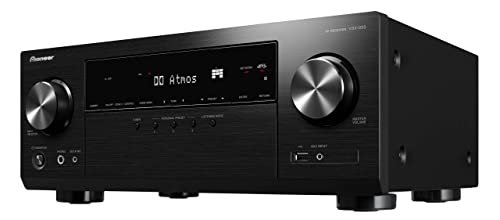
Flexible Surround Pick – Pioneer VSX-935
Among Dolby Atmos AV receivers, the Pioneer VSX-935 is a practical choice for building a seven-channel surround system. It supports Dolby Atmos and DTS:X, with upmixing and a Dolby Atmos Height Virtualizer for flexible speaker arrangements.
Best For: Buyers who want immersive audio formats and network connectivity in a 7.2-channel receiver.
Pros:
- Supports Dolby Atmos, DTS:X, and their respective upmixing options.
- Height Virtualizer offers an option when physical height speakers are not installed.
- Wi-Fi and Bluetooth provide wireless connectivity.
Cons:
- Seven powered channels limit a Dolby Atmos setup to 5.2.2 rather than a larger height-speaker layout.
- The 170-watt rating is measured with one channel driven at 10% THD; the specified two-channel rating is 80 watts at 8 ohms.
Choose this model for its surround-format flexibility, but compare power specifications using the stated test conditions rather than the largest wattage figure.
Gaming and 8K Pick – Denon AVR-S970H
The Denon AVR-S970H stands out among Dolby Atmos AV receivers for buyers pairing a surround system with an 8K TV or gaming console. Its seven channels support 7.2 or 5.2.2 speakers, while 8K/60Hz pass-through and gaming features accommodate modern video sources.
Best For: Medium-size rooms that need a 5.2.2 Atmos setup, gaming features, and music streaming.
Pros:
- Supports Dolby Atmos and DTS:X with seven powered channels.
- Offers three 8K HDMI inputs plus VRR, QFT, and ALLM support.
- Includes a phono input and HEOS multi-room streaming over Wi-Fi or Bluetooth.
Cons:
- Seven powered channels cannot run a four-height-speaker Atmos layout.
- Only three of its six HDMI inputs are identified as 8K inputs.
This is a well-matched option if gaming connectivity matters as much as surround sound; check that three 8K inputs cover the sources you plan to connect.
Multi-Room Music Pick – Yamaha RX-V6A
The Yamaha RX-V6A is worth considering among Dolby Atmos AV receivers when music around the house matters alongside movie sound. This seven-channel model combines Dolby Atmos, DTS:X, and Atmos Height Virtualization with MusicCast multi-room audio.
Best For: Households looking for a 7.2-channel home theater receiver with broad streaming and multi-room options.
Pros:
- Supports Dolby Atmos, DTS:X, and Atmos Height Virtualization.
- MusicCast, AirPlay 2, Spotify Connect, Wi-Fi, and Bluetooth offer multiple listening options.
- Seven HDMI inputs, eARC, and YPAO R.S.C. multipoint calibration support a connected theater setup.
Cons:
- Its seven powered channels do not accommodate a four-height-speaker Atmos system.
- It has one HDMI output, which may not suit setups needing two displays connected directly to the receiver.
Pick the RX-V6A if you will use its MusicCast and streaming features; its single HDMI output is the key connection limit to check first.
Best for Multiroom Audio – Denon AVR-X1800H
Among dolby atmos av receivers, the Denon AVR-X1800H is a practical choice for a small-to-medium room that also needs music throughout the home. Its seven amplified channels support a 5.2.2 Dolby Atmos layout, while HEOS handles multiroom streaming.
Best For: Buyers who want a 5.2.2 theater setup and HEOS music streaming in other rooms.
Pros:
- Three 8K HDMI inputs support 8K/60Hz and 4K/120Hz pass-through.
- Supports Dolby Atmos, DTS:X and virtual height effects.
- On-screen setup guide and color-coded connections simplify installation.
- HEOS, AirPlay 2 and Bluetooth offer several streaming options.
Cons:
- Seven amplified channels limit a physical Atmos setup to 5.2.2.
- Only three of its four listed HDMI ports are dedicated 8K inputs.
The X1800H balances current video support with approachable setup. Choose it when multiroom listening matters as much as surround sound.
Best for Streaming Options – Yamaha RX500A
The Yamaha RX500A stands out among dolby atmos av receivers for its broad selection of music services and connection options. This seven-channel model supports a 5.2.2 speaker layout, 4K/120Hz and 8K/60Hz video, and Bluetooth Multipoint for switching between two paired sources.
Best For: Listeners who use several streaming platforms and want a 5.2.2 theater setup.
Pros:
- Supports Spotify Connect, Google Cast, AirPlay 2, TIDAL Connect and Qobuz Connect.
- Handles Dolby Atmos and DTS:X with a 5.2.2 speaker layout.
- Supports 4K/120Hz, 8K/60Hz, VRR and ALLM.
- Included setup microphone enables automatic room optimization.
Cons:
- Seven channels do not allow more than two physical height speakers in a 5.2.2 layout.
- Its stated 70W output is lower than the 80W figures listed for the Denon and Onkyo here.
Room optimization and a guided setup help make the RX500A approachable. Its main draw is the flexibility to play music from many services without changing your home-theater plans.
Best for Gaming Features – Onkyo TX-NR5100
For shoppers comparing dolby atmos av receivers around console features, the Onkyo TX-NR5100 puts 4K/120Hz HDR pass-through, VRR, ALLM and Quick Frame Transport at the forefront. Its eARC connection can also carry Dolby Atmos audio from compatible TV apps to the receiver.
Best For: Console players who want modern HDMI gaming features alongside surround sound.
Pros:
- Supports 4K/120Hz HDR pass-through plus VRR, ALLM and QFT.
- eARC supports Dolby Atmos and other listed high-bitrate audio formats from a TV.
- Seven channels and 80W stated output support a surround setup.
- Includes a Klipsch Optimize Mode for compatible speaker setups.
Cons:
- The supplied specifications list four HDMI ports, fewer than the Yamaha’s five.
- Bluetooth is the only wireless technology specified in the supplied details.
The TX-NR5100 makes the strongest case here when responsive gaming video is the priority. Check its connection count against your consoles and other sources before buying.
How We Picked These Dolby Atmos Av Receivers
We focused on receivers that cover common buying needs: a first Atmos system, a gaming-focused setup, and a larger theater with room to expand. We weighed powered speaker channels, subwoofer outputs, HDMI features, room-calibration options, streaming support, and connectivity. Published wattage is less useful on its own because brands may measure it under different conditions.
Specifications can vary by region and production run. Before ordering, check the manufacturer’s current specifications for the exact model and confirm that it has enough HDMI inputs and powered channels for your plans.
Quick Comparison: Match the Receiver to the Setup
Most models here are 7.2-channel receivers. With seven powered channels, you can generally choose a 5.1.2 Atmos layout—five ear-level speakers, one subwoofer, and two height speakers—or a conventional 7.1 layout. The Denon AVR-X4800H offers nine powered channels for layouts such as 5.1.4 or 7.1.2. Its 9.4 designation indicates additional subwoofer connectivity; it does not mean four additional powered speaker channels.
For a straightforward 5.1.2 system, compare the Denon AVR-X1700H and AVR-X1800H, Onkyo TX-NR5100 and TX-NR6100, Pioneer VSX935, Sony STR-AN1000, and Yamaha options based on the inputs and features you will actually use. The Denon AVR-S970H is another 7-channel choice to consider if its connection mix suits your setup.
Key Buying Factors for Dolby Atmos Av Receivers
Speaker Channels and Expansion
Count the speakers you want to install now and later. A 7-channel receiver is enough for two height speakers in a 5.1.2 arrangement, but a four-height-speaker Atmos system needs at least nine powered channels. Check whether a receiver supports external amplification if future expansion matters.
HDMI and Gaming Compatibility
Match the receiver’s HDMI inputs to your console, media player, and display. If you need 4K at 120 Hz, variable refresh rate, or 8K passthrough, verify support on the specific input ports—not just in a broad “8K” claim. Also confirm eARC support if you plan to send audio back from a TV’s built-in apps.
Room Correction and Everyday Use
Automatic calibration can help set speaker distances and levels, but its available controls differ by model. Consider the setup interface, remote or app experience, Wi-Fi streaming ecosystem, and whether features such as HEOS or MusicCast fit devices you already own. Speaker impedance guidance and ventilation requirements matter, too, especially in an enclosed cabinet.
Who Should Buy Which Dolby Atmos Av Receivers?
Choose a 7-channel model if you want a compact 5.1.2 Atmos system without paying for unused amplification. Prioritize verified HDMI gaming features if a console is a main source, or favor the streaming platform and controls you prefer if you listen to music every day. For four height speakers or a larger room layout, start with the nine-channel AVR-X4800H and confirm its full configuration meets your needs. The best value is the receiver that runs your intended speaker layout and connects all your sources, with a little room left for your next upgrade.