
Small venues demand stage monitors that deliver clear vocals and instruments without overwhelming the room. The right wedge can improve performer confidence while keeping setup, feedback, and volume under control.
Our selection includes compact powered and passive monitors suited to rehearsal rooms, bars, churches, studios, and other space-conscious stages.
Best 10 Stage Monitors for Small Rooms Picks for 2026
Compact Powered Choice

- 350W powered 8-inch monitor
- Built-in mixer and Bluetooth
- Portable wedge-ready design
Best For: Small gigs, home studios, DJs, and presentations
Traditional Wedge Monitor

- 10-inch two-way floor wedge
- Titanium compression horn driver
- 150W RMS, 300W peak
Best For: Wired small-stage systems with external amplification
Feedback-Controlled Monitor

- 250W powered 12-inch monitor
- Adjustable feedback filter
- Integrated limiter and multiple inputs
Best For: Live performers needing feedback control in small venues
High-Headroom Passive Wedge
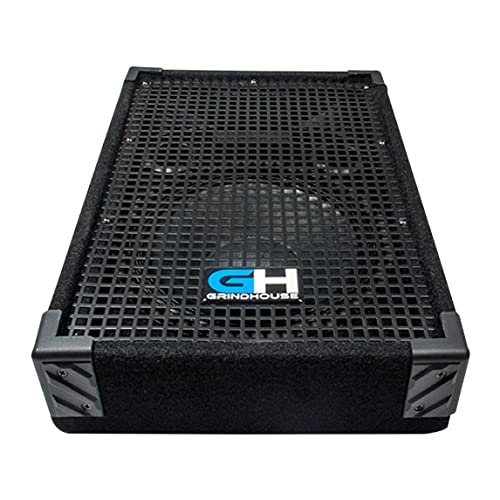
- 300W RMS, 600W peak rating
- 10-inch 8-ohm passive wedge
- Built for PA, DJ, and karaoke use
Best For: Modular wired PA systems with external amplification
Ultra-Compact Pick

- 25-watt output with a 3-inch ceramic driver
- Includes stand/wall-mount hardware
- Three-year warranty
Best For: Small rooms and personal monitoring
High-Output Classic
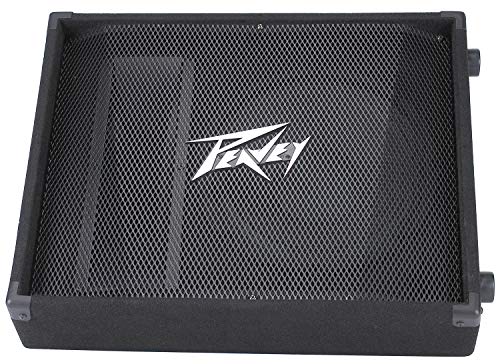
- 500-watt program power handling
- 12-inch woofer and titanium compression driver
- Adjustable 30- or 45-degree floor angle
Best For: Powerful monitoring in compact venues
Balanced 10-Inch Option
Sound Town METIS-10M Stage Monitor

- 10-inch woofer and 1-inch compression tweeter
- 300-watt peak handling at 8 ohms
- Parallel 1/4-inch jacks for daisy chaining
Best For: Portable small-venue PA systems
Reliable Passive Power

- 12-inch woofer with 1-inch compression driver
- 300W program and 600W peak handling
- Pole socket, handles, and corner protection
Best For: Small-room PA setups with a separate amplifier
Easy Active Control

- 300W active 2-way monitor system
- Adjustable feedback filter and limiter
- Built-in processor and three-band EQ
Best For: Self-powered small-room live and playback monitoring
Compact Active Focus

- 800W Class-D active monitor
- Coaxial 10-inch driver with 1-inch tweeter
- Combo input, link output, and FOH/Monitor switch
Best For: Compact small-room monitoring for performers and DJs
Compact Powered Choice – ALTO TX408 8" PA Speaker
For stage monitors for small rooms, the ALTO TX408 is a compact powered option with an 8-inch woofer, 350W bi-amplified output, and a wedge-monitor configuration. Its built-in mixer and Bluetooth support make it practical for small gigs, rehearsals, home studios, and presentations where simple setup matters.
Best For: Small live performances, home studios, DJs, presentations, and fitness or rehearsal spaces needing a powered monitor with flexible inputs.
Pros:
- Compact 8-inch design with 350W Class-D amplification.
- Built-in two-channel mixer supports microphone, line-level, and Bluetooth inputs.
- Bluetooth True Wireless Stereo, mix output, pole socket, and wedge-monitor use provide setup flexibility.
- Metal grille, sturdy enclosure, and ergonomic handles support portability.
Cons:
- Not water resistant.
- Requires corded electric power.
- Bluetooth range is listed at 75 feet, which may not suit every venue layout.
The TX408 stands out when you want an all-in-one powered monitor without adding a separate amplifier or mixer. Its compact footprint and multiple input options are especially useful in small rooms, though larger setups may need additional speakers for broader coverage.
Traditional Wedge Monitor – Seismic Audio SA-10MT 10"
Seismic Audio - SA-10MTSingle - 10" Floor / Stage Monitor Wedge Style with Titanium Horn
Check Price On AmazonThe Seismic Audio SA-10MTSingle is a straightforward 10-inch floor wedge for stage monitors for small rooms. It uses a wired design with a 10-inch speaker, titanium compression horn driver, and 150W RMS rating, making it suited to users who already have compatible amplification and cabling.
Best For: Small-stage bands, DJs, and live-sound setups that need a conventional passive-style floor monitor with wired connections.
Pros:
- 10-inch two-way speaker with a titanium horn driver.
- Rated at 150W RMS and 300W peak.
- Floor-mount wedge design is purpose-built for stage monitoring.
- Supports wired 1/4-inch and Speakon connections.
Cons:
- Speaker-only design requires external amplification.
- Heavier than the compact powered option at 22 pounds.
- Not water resistant.
This monitor is a sensible fit for a small room when your system already includes an amplifier or powered mixer. Its wedge form and titanium horn focus on practical stage use, but it is less convenient for users seeking an all-in-one powered solution.
Feedback-Controlled Monitor – Behringer EUROLIVE F1220D
For stage monitors for small rooms where feedback control is important, the Behringer EUROLIVE F1220D combines a 12-inch woofer with a 250W bi-amped powered design. Its adjustable feedback filter and integrated limiter provide useful control for live performances and music playback.
Best For: Live performers and small venues that want a powered monitor with feedback filtering, limiter protection, and broad wired connectivity.
Pros:
- Powered 250W bi-amped monitor with a 12-inch woofer.
- Adjustable feedback filter helps manage troublesome frequencies.
- Integrated limiter provides speaker protection.
- Offers XLR, 1/4-inch, RCA, and Speakon connectivity.
Cons:
- Larger and heavier than an 8-inch compact monitor at 23.6 pounds.
- Not water resistant.
- Its 12-inch format may take more floor space in a particularly tight room.
The F1220D is a strong choice when monitoring control matters more than minimum size. It offers useful connection options and built-in protection, while its larger cabinet may be better suited to small venues with enough floor space for a 12-inch wedge.
High-Headroom Passive Wedge – Grindhouse GH10M 10" Monitor
The Grindhouse GH10M is a passive 10-inch wedge designed for stage monitors for small rooms, DJ monitors, karaoke, and live sound. With a listed 300W RMS and 600W peak rating, it offers substantial headroom for a compact floor monitor when paired with suitable external amplification.
Best For: PA, DJ, karaoke, and live-sound users who already have an amplifier and want a rugged wired 10-inch wedge.
Pros:
- 10-inch passive wedge rated at 300W RMS and 600W peak.
- 8-ohm impedance suits compatible PA amplification.
- Designed for PA monitors, DJ monitors, live sound, and karaoke.
- Offers 1/4-inch TS and speaker-wire terminal connections.
Cons:
- Requires a separate amplifier or powered mixer.
- No wireless communication technology.
- Not water resistant.
The GH10M makes sense for buyers building a modular PA system and prioritizing output capacity over integrated features. It is less plug-and-play than a powered monitor, but its 10-inch wedge format can fit neatly into small-room stage setups.
Ultra-Compact Pick – Galaxy Audio NSPA Nano Spot
For stage monitors for small rooms, the Galaxy Audio NSPA Nano Spot is a highly compact option designed for close-range monitoring. Its 3-inch ceramic driver, 25-watt output, and included stand/wall-mount hardware suit space-conscious setups where a full-size floor monitor would be excessive.
Best For: Small rooms, personal monitoring, and wall- or stand-mounted setups.
Pros:
- Compact 3-inch speaker with 25-watt maximum output
- Included wall/stand bracket mount kit and rubber feet
- 150Hz–17kHz frequency response and bass-boost feature
- Three-year warranty
Cons:
- Limited low-frequency extension compared with 10- or 12-inch monitors
- Not waterproof
- Wired power is required
The NSPA is the easiest fit when floor space is tight and monitoring needs are personal or close-range. Its small driver will not deliver the fuller stage volume of larger monitors, but its mounting flexibility makes it particularly practical for compact rooms.
High-Output Classic – Peavey PV 12M Floor Monitor
The Peavey PV 12M brings substantial output to a small-room stage-monitoring setup, though its 12-inch cabinet requires more floor space than compact alternatives. It combines 500 watts of program power handling with a Sheffield Pro woofer and titanium-diaphragm compression driver for vocal and instrument monitoring.
Best For: Small venues needing powerful floor monitoring and rugged construction.
Pros:
- 500-watt program and 1,000-watt peak power handling
- 12-inch Sheffield Pro 1200+ woofer with 2.5-inch voice coil
- 30- or 45-degree floor angles plus pole-mount capability
- Heavy-duty grille, steel handle, and five-year warranty
Cons:
- Large and heavy at 41 pounds
- More monitor than many very small rooms require
- Not waterproof
The PV 12M is a strong choice when output and durability matter more than compactness. Its angled enclosure can work well in a small venue, but confirm that the 24-by-20-by-15-inch footprint and 41-pound weight fit your stage.
Balanced 10-Inch Option – Sound Town METIS-10M Stage Monitor
For stage monitors for small rooms, the Sound Town METIS-10M offers a middle ground between ultra-compact personal speakers and larger 12-inch cabinets. This passive floor monitor uses a 10-inch woofer, 1-inch compression tweeter, and 150-watt RMS/300-watt peak handling in a portable carpeted enclosure.
Best For: Small live venues, bars, churches, and portable PA setups needing a conventional floor monitor.
Pros:
- 10-inch woofer with 1-inch compression tweeter
- 150-watt RMS and 300-watt peak power handling at 8 ohms
- Parallel 1/4-inch jacks support daisy chaining
- Metal grille, reinforced corners, and recessed side handle
Cons:
- Passive design requires an external amplifier
- Heavier and larger than a personal monitor
- One-year warranty
The METIS-10M is a practical compromise for small stages that need more coverage than a 3-inch monitor but less bulk than a 12-inch model. Its passive connections and daisy-chainable jacks are useful when integrating it into an existing PA system.
Reliable Passive Power – Yamaha BR12M
The Yamaha BR12M is a passive 12-inch floor monitor suited to small rooms that need clear, punchy stage sound without built-in amplification. Its 300-watt program handling, 600-watt peak rating, and 97dB sensitivity make it a practical choice when paired with a compatible mixer or amplifier.
Best For: Small-room live performances, PA systems, and users who already have an amplifier or powered mixer.
Pros:
- 12-inch woofer and titanium compression driver provide full-range monitoring.
- 90×40-degree horn supports controlled high-frequency coverage.
- Built-in pole socket, steel handles, and corner protectors add placement flexibility and durability.
- High 97dB sensitivity and 600-watt peak handling suit sound reinforcement setups.
Cons:
- Passive design requires a separate amplifier or powered mixer.
- At 15.6 kg, it is less convenient to move than smaller active monitors.
For small rooms, the BR12M is a straightforward, durable monitor option when your system already includes amplification. Its floor-monitor format and pole socket allow flexible positioning for performers or front-of-house use.
Easy Active Control – Behringer EUROLIVE F1320D
The Behringer EUROLIVE F1320D is an active 12-inch monitor that simplifies stage-monitor setup in small rooms by combining a Class-D amplifier with onboard processing. Its 300-watt output, adjustable feedback filter, limiter, and three-band EQ provide useful control for live and playback applications.
Best For: Small-room performers and playback setups that need a self-powered monitor with feedback and tone controls.
Pros:
- Built-in 300-watt Class-D amplification avoids a separate power amplifier.
- Adjustable feedback filter helps manage common stage-monitor feedback issues.
- Integrated limiter and sound processor support system control and speaker protection.
- Three-band EQ provides practical tonal adjustment.
Cons:
- The 12-inch cabinet weighs 33.1 pounds, limiting portability compared with compact monitors.
- It is corded and not water resistant.
The F1320D is a capable all-in-one choice for small rooms where quick setup and feedback management matter. Its active design reduces equipment count while retaining basic EQ and protection features.
Compact Active Focus – Samson RSXM10A
The Samson RSXM10A is a compact active monitor for small rooms, featuring a coaxial 10-inch design and up to 800 watts of output power. Its combo input, link output, FOH/Monitor selector, and pole-mount receptacle make it adaptable for stage monitoring, DJ booths, and sound-engineering work.
Best For: Small-room performers, DJs, and sound engineers who want a compact powered monitor with flexible connections.
Pros:
- Lightweight Class-D active design delivers up to 800 watts of output.
- Coaxial 10-inch woofer and 1-inch tweeter provide a compact monitoring format.
- XLR/1/4-inch combo input and XLR link output support common live-audio connections.
- FOH/Monitor selector and 1 3/8-inch pole mount improve setup flexibility.
Cons:
- Its 10-inch driver has less low-frequency surface area than a 12-inch monitor.
- At 30 pounds, it is not the lightest compact monitor available.
- It requires corded power and is not waterproof.
The RSXM10A balances compact size, active amplification, and connection flexibility. It is a strong fit for small rooms where easy routing and a smaller footprint are more important than a larger woofer.
How We Picked These Stage Monitors for Small Rooms
We focused on monitor designs that balance usable output with manageable size and practical placement. The lineup includes powered models for simpler setups and passive wedges for systems that already use an external amplifier. We also considered woofer size, frequency coverage, feedback-control features, connection flexibility, portability, and suitability for vocals, instruments, playback, and spoken word.
Power ratings are not directly comparable across every manufacturer, so treat wattage as one specification rather than a guarantee of loudness. Cabinet design, sensitivity, amplifier quality, and room acoustics all affect real-world performance.
Quick Comparison
| Best For | What to Prioritize | Recommended Direction |
|---|---|---|
| Simple plug-and-play setups | Built-in amplification and mixer-friendly inputs | Powered monitors |
| Existing PA systems | Impedance, power handling, and amplifier matching | Passive wedges |
| Very tight spaces | Compact enclosure and controlled volume | Small-format personal or 8-inch monitors |
| More low-end support | Larger woofer and adequate room clearance | 10- or 12-inch monitors |
Key Buying Factors for Stage Monitors for Small Rooms
Powered or Passive
Powered monitors include an amplifier, reducing the amount of equipment and cabling required. They are usually the easiest choice for solo performers, small bands, and portable setups. Passive models can be more economical when you already own a compatible power amp, but matching impedance and power ratings is essential.
Size, Coverage, and Volume
An 8-inch monitor can be easier to position in a cramped room and may provide sufficient vocal clarity at moderate levels. Ten- and 12-inch models generally offer more headroom and fuller low-mid response, but they occupy more floor space and can encourage excessive stage volume. Choose the smallest cabinet that comfortably meets your monitoring needs.
Feedback Control and Placement
Feedback performance depends on microphone technique, equalization, cabinet angle, and placement—not just a built-in filter. Aim the monitor toward the performer’s ears, keep microphones behind the speaker’s main output axis, and avoid pointing the cabinet directly at nearby walls or reflective surfaces.
Connections and Setup
Check whether the monitor accepts the connectors and signal level used by your mixer or source. Confirm power requirements for powered models, and verify the passive speaker’s impedance before connecting it to an amplifier. A sturdy grille, corner protection, carry handles, and reliable controls also matter for frequent transport.
Who Should Buy Which Stage Monitors for Small Rooms?
Choose a compact powered model if you want the fastest setup and predictable operation in a rehearsal room or small venue. Pick a larger powered wedge when performers need more headroom or several people must hear the same mix. Passive monitors make sense for churches, DJs, and bands with an established amplifier or installed PA system. For extremely limited floor space or low-volume acoustic use, a personal monitor or smaller wedge may be the most practical solution.